
“The future is particularly unpredictable these days.”
Welcome to the 156th Edition of the Biweekly Global Business Update – The war now unfolding between Iran, Israel and the United States is rapidly becoming one of the most consequential geopolitical shocks to the global economy in decades. What began as a regional military confrontation has already triggered the largest disruption to global oil supply in modern history, sending energy markets, trade routes and supply chains into immediate turmoil.
At the center of the crisis is the Strait of Hormuz, the narrow waterway through which roughly 20% of the world’s daily 107 million barrels a day oil production and a large share of global liquefied natural gas normally flows. Missile attacks, security risks and insurance restrictions have sharply reduced tanker traffic through the strait, trapping a significant portion of global oil supplies on the far side of the Persian Gulf. Global oil supply is projected to fall by roughly 8 million barrels per day, forcing governments to release emergency reserves and pushing energy markets into heightened volatility.
As a result of the Iran war air freight rates are surging as airlines reroute flights around the conflict zone. Shipping delays are mounting across key trade corridors. Fertilizer markets are tightening as disruptions to natural gas supplies ripple through global agriculture supply chains. These pressures are beginning to push up costs across sectors ranging from transportation and manufacturing to food production.
All of this is unfolding at a moment when the global economy was already facing slowing growth, rising trade tensions and persistent inflation pressures.
For global business leaders, the message is clear: geopolitics is once again shaping the direction of the world economy. The Iran war now has the potential to influence energy prices, logistics costs, inflation and investment decisions across global markets in the months ahead.
The developments in my 156th newsletter below illustrate how a single geopolitical flashpoint can rapidly ripple through energy markets, trade routes, supply chains and global growth. This will make the next few months a critical period for anyone doing business internationally.
This edition’s book review highlights: “Crisis: A Global Case Primer by Jason Miklian and John E Katsos , 2025. In a world defined by geopolitical shocks, supply-chain disruptions, pandemics, and financial volatility, Crisis: A Global Case Primer offers a timely and practical exploration of how organizations confront and sometimes survive moments of extreme uncertainty.
++++++++++++++++++++++++++++++++++++++++++++++++++++++++++++++++++++++++++++++++++++++++++++++
To receive our biweekly newsletter by email every other Tuesday, click here https://insider.edwardsglobal.com
+++++++++++++++++++++++++++++++++++++++++++++++++++++++++++++++++++++++++++++++++++++++++++++
The mission of this newsletter is to use trusted global and regional information sources plus our network of 20+ in-country Associates to update our global readers on key global and local trends that can impact the success of their businesses at home and abroad. We subscribe to about 40 international information sources to keep our readers up to date on the world’s business. We do not get involved with or report on politics!
PLEASE NOTE: Some of the information sources that we provide links to in our newsletter require a paid subscription to directly access them. Clicking on a link may not give the reader access to the content.
Edited and curated by: William (Bill) Edwards, CEO & Global Business Advisor, Edwards Global Services, Inc. (EGS), Irvine, California, USA. Contact Bill with questions, comments and contributions. Bedwards@edwardsglobal.com, +1 949 375 1896
Link to our current and past newsletters: https://edwardsglobal.com/geowizard/
+++++++++++++++++++++++++++++++++++++++++++++++++++++++++++++++++++++++++++++++++++++++++
First, A Few Words of Wisdom From Others For These Times
“The future is particularly unpredictable these days.”, Howard Marks
“The only thing new in the world is the history you do not know.”, Harry S. Truman
“We are not makers of history. We are made by history.”, Martin Luther King Jr.
+++++++++++++++++++++++++++++++++++++++++++++++++++++++++++++++++++++++++++++++++++++++++++
Highlights in issue #156:
The Energy Mix of the World’s 10 Largest Economies
Where the World’s Oil Comes From by Region
Oil Risk Highest for Philippine Bonds in Asia, China Insulated
Small Business Startup Sentiment Rebounds
Tricky negotiations begin Monday to renew a trade pact between the United States, Mexico and Canada
Why Private Equity Should Bet On International Franchising
Franchise Global News Section: Gong cha®, Papa John’s®, Jiffy Lube®, Mixue Bingcheng and Wendy’s®
++++++++++++++++++++++++++++++++++++++++++++++++++++++++++++++++++++++++++++++++++++++++++++
Interesting Data, Articles and Studies
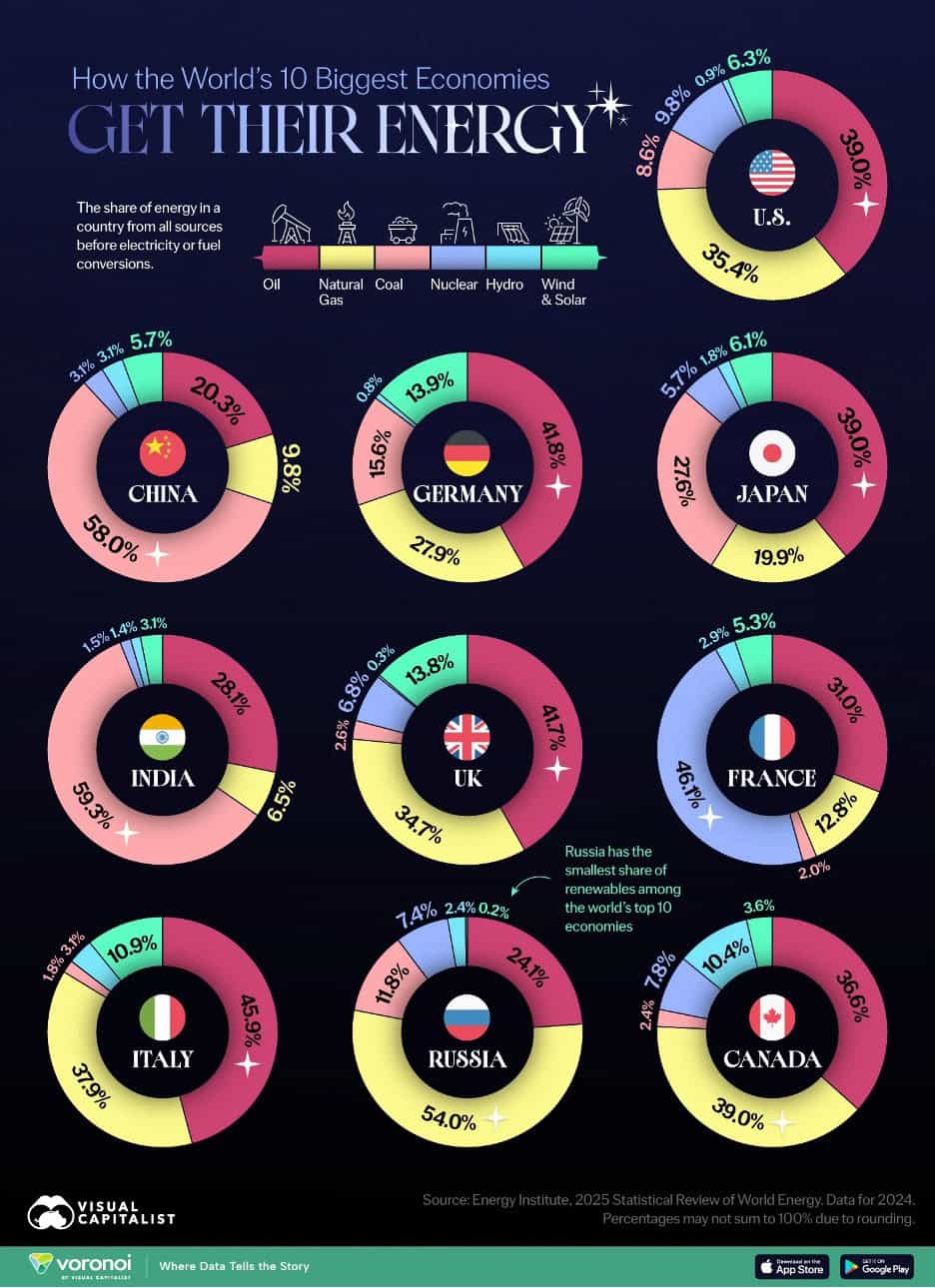
“The Energy Mix of the World’s 10 Largest Economies – Oil is the largest energy source in six of the world’s 10 biggest economies, including the U.S., Germany, Japan, the UK, and Italy. Coal dominates energy supply in China and India, accounting for nearly 60% of their energy mixes. France stands out for nuclear power, which provides over 46% of its energy mix, the highest share among the group. Oil remains the largest energy source in six of the 10 biggest economies, including the United States, Germany, Japan, the United Kingdom, and Italy. In these countries, oil plays a major role in transportation and industrial sectors. Italy has the highest reliance on oil among the group, with nearly 46% of its energy coming from petroleum. Germany and the UK also depend heavily on oil, though both have been expanding renewable energy capacity in recent years.”, Visual Capitalist and the Energy Institute, March 13, 2026
===============================================================================================
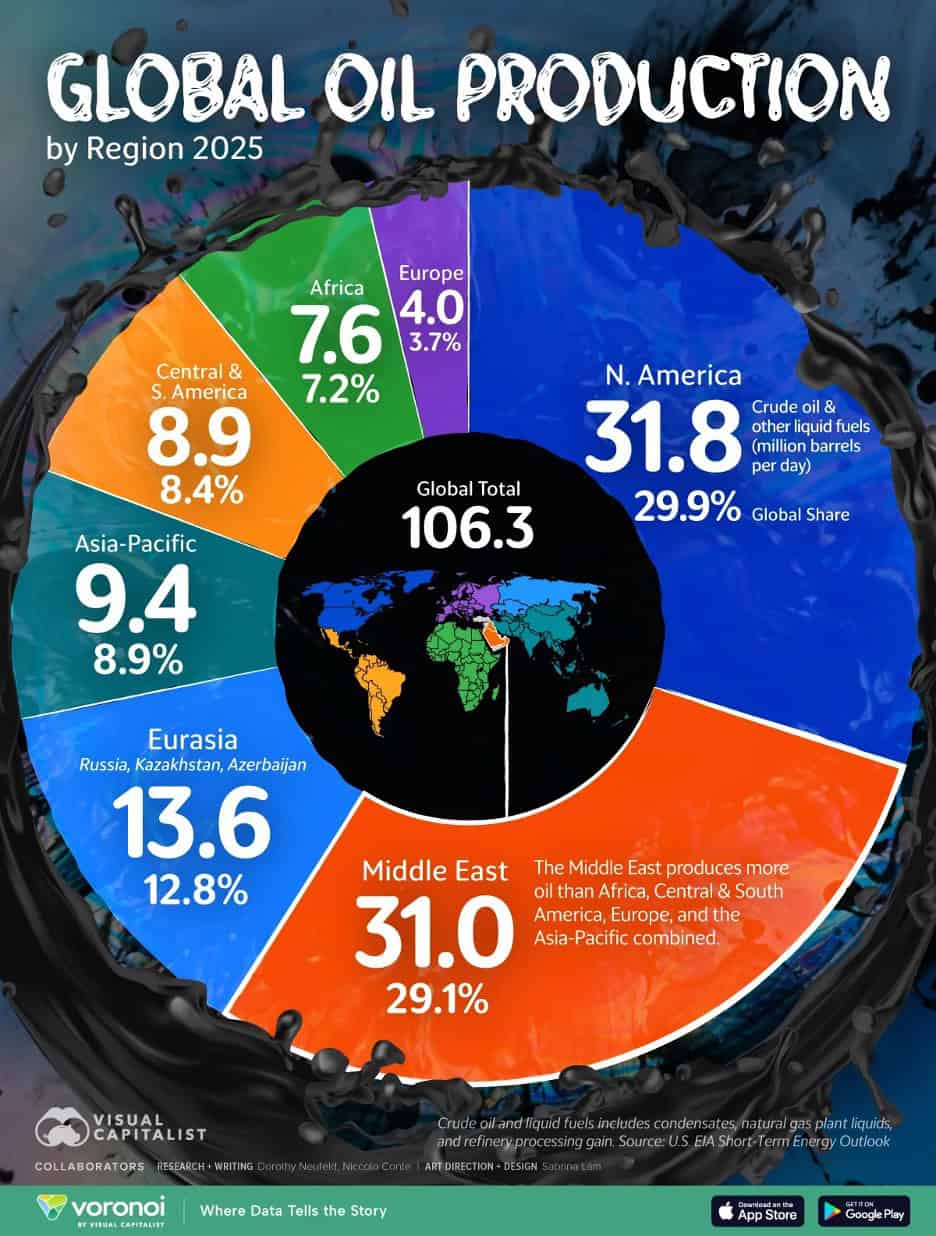
“Where the World’s Oil Comes From by Region – North America is the world’s largest oil-producing region in 2025, generating over 31 million barrels per day, equal to nearly 30% of global supply. The Middle East produces over 29% of the world’s oil, led by Saudi Arabia and Iran. Europe, excluding Russia, produces less than 4% of total oil production, the smallest share by region. The world produced roughly 106 million barrels of oil per day in 2025, according to estimates from the U.S. Energy Information Administration (EIA). Just two regions dominate global supply. North America and the Middle East together produce nearly 60% of the world’s oil, underscoring their outsized influence on energy markets.”, Visual Capitalist and the U.S. Energy Information Administration, March 10, 2026
++++++++++++++++++++++++++++++++++++++++++++++++++++++++++++++++++++++++++++++++++++++++++++++
Global Supply Chain, Energy, Commodities, Inflation, Taxes, Tariffs & Trade Issues
“Middle East War Is Causing Largest Oil Supply Disruption in History, IEA Says – Oil supply is projected to plunge by 8 million barrels a day in March. The International Energy Agency slashed its oil supply growth forecast to 1.1 million b/d this year amid the Middle East war. IEA member countries released 400 million barrels from emergency stocks, the largest in history, as the Strait of Hormuz remains effectively closed. The IEA now expects global oil demand to rise by 640,000 b/d this year, down from an earlier 850,000 b/d forecast. In March, supply is projected to plunge by 8 million barrels a day to 98.8 million barrels a day, the lowest levels since the first quarter of 2022.”, The Wall Street Journal, March 12, 2026
=================================================================================================
“Air freight rates soar as Middle East conflict blocks trade routes – “Air freight rates have risen by as much as 70% on some routes since the start of the U.S.-Israeli war on Iran, data shows, as the conflict limits flights, blocks some ocean shipments and pushes up jet fuel costs. Rates on routes between South Asia and Europe have been the most affected by Middle Eastern airspace closures and security issues, industry experts said, after the conflict has stranded more than 100 container ships in the area around the critical Strait of Hormuz oil export corridor. “The shift to air cargo is significant because air freight handles about one-third of global trade by value, making rate spikes a potential inflationary pressure on goods ranging from fresh food to pharmaceuticals and electronics.”, Reuters, March 13, 2026
===============================================================================================
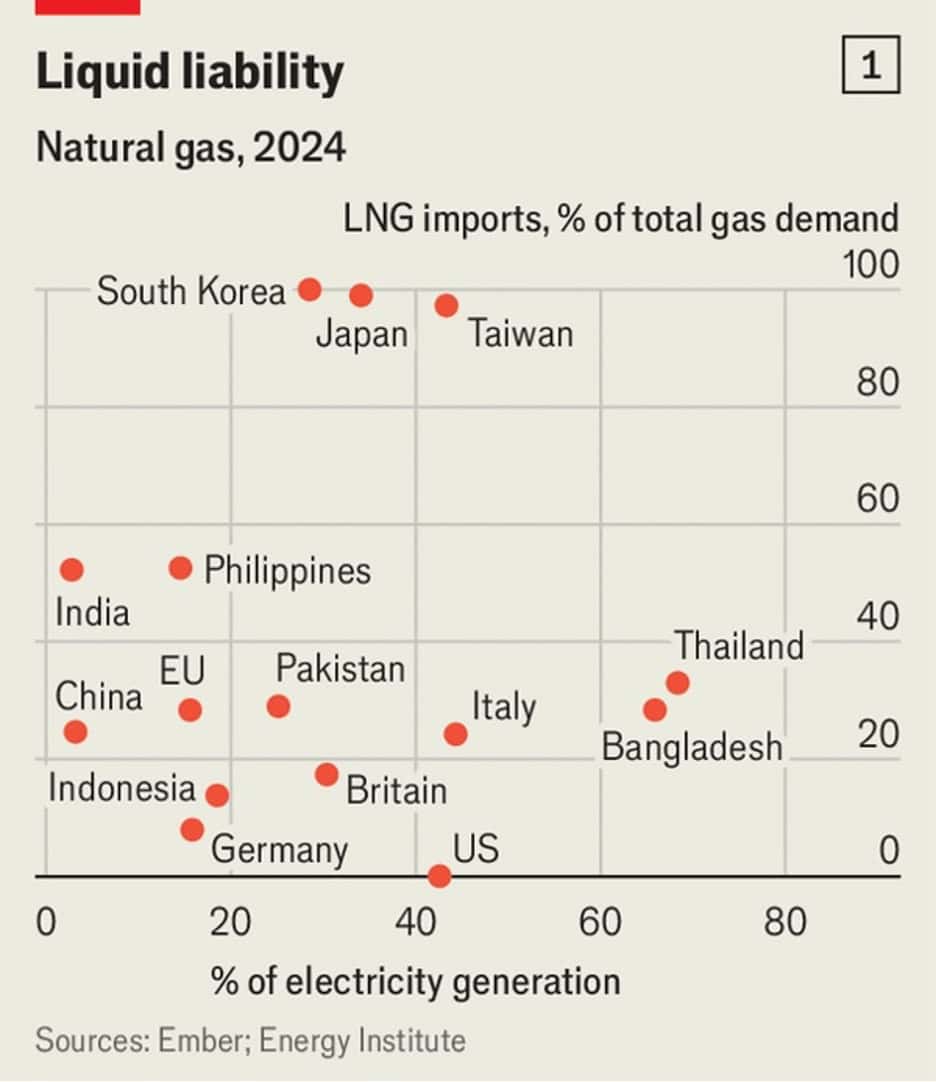
“The damage to the world economy from the Iran war will be severe, but uneven – It has already caused the biggest energy supply shock in history. And the shock emanating now from the Strait of Hormuz is huge. Iranian missiles have trapped about 15% of global oil supplies on the far side of the strait. That is roughly twice the disruption the world suffered in the 1970s, offsetting the fact that the energy-intensity of the world economy has fallen by half since then. About a fifth of the world’s shipments of liquefied natural gas (lng) have been halted, too, and the shock is spreading to other commodities. The price of fertiliser, which is made using natural gas, is surging, stoking fears of food shortages.”, The Economist, March 12, 2026
============================================================================================
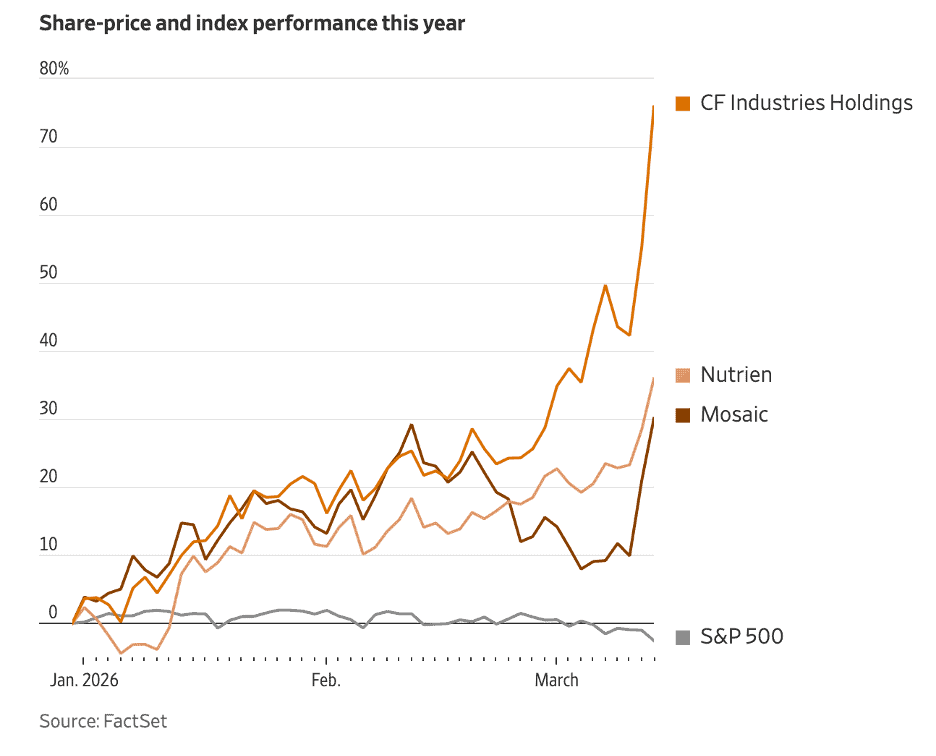
“Fertilizer Stocks Jump With Shipments Stuck at the Strait of Hormuz – Investors flock to U.S. fertilizer producers, which can access cheap natural gas; farmers are expected to shift to less-dependent crops. The Middle East fighting has choked off big chunks of the world’s supply of ammonia, urea, sulfur and phosphates. It has also blocked roughly 20% of the supply of liquefied natural gas, or LNG, upon which fertilizer makers in Europe and elsewhere rely. Benchmark natural-gas prices in Europe have climbed 58% since the U.S.-Israeli bombardment of Iran began. For American farmers already shouldering higher costs, the Mideast disruption has boosted prices for certain fertilizers by about 30%.”, The Wall Street Journal, March 12, 2026
===============================================================================================
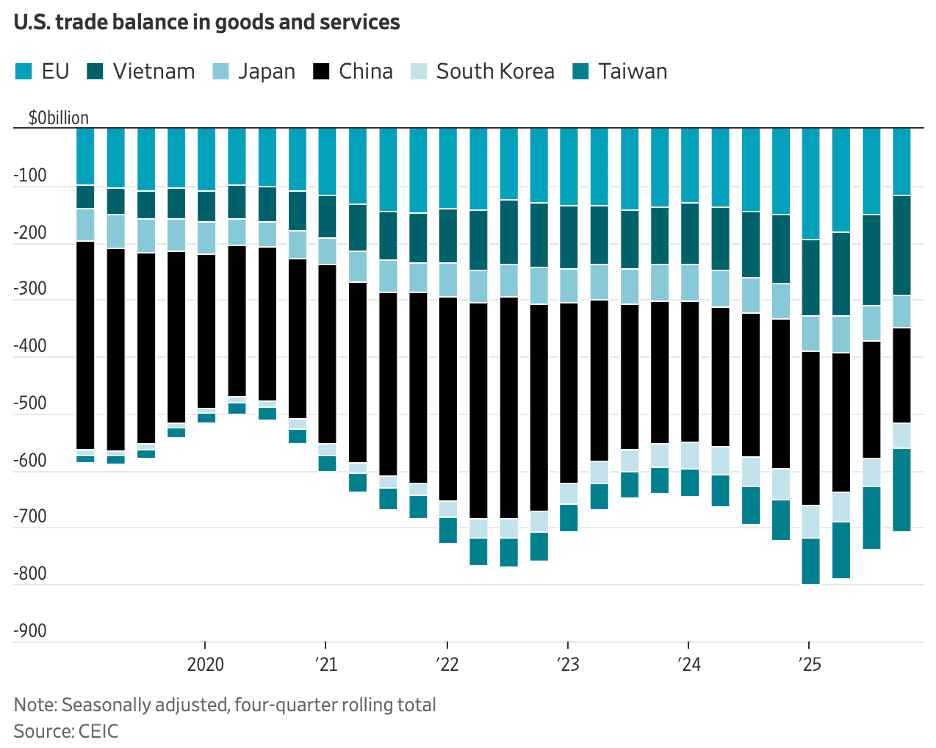
“Allies to Trump: We’ll Live With Tariffs, Just Don’t Make Them Any Higher – U.S. trading partners are pushing President Trump to stick to previously agreed tariff levels after his administration kicked off probes aimed at replacing the levies struck down by the Supreme Court. This past week, U.S. Trade Representative Jamieson Greer said the U.S. was starting investigations under Section 301 of the Trade Act of 1974, citing what he called unfair practices such as running trade surpluses and building up too much industrial capacity. The move is likely to lead to tariffs on most of America’s major trading partners including the European Union, Mexico, China, Japan, South Korea, India and others.”, The Wall Street Journal, March 14, 2026
===============================================================================================
“Tricky negotiations begin Monday to renew a trade pact between the United States, Mexico and Canada – Every day more than $4 billion worth of goods cross the United States’ borders with Canada and Mexico – U.S. auto parts headed for car factories in northern Mexico, cartons of Mexican avocados bound for California supermarkets, Canadian aluminum destined to become cans of Campbell Soup. Much of this bustling cross-border commerce is duty-free, thanks to the US-Mexico-Canada Agreement, or USMCA, that President Donald Trump negotiated with America’s northern and southern neighbors during his first term. But the future of the USMCA , which took effect July 1, 2020, is cloudy as the three countries begin what could be a tempestuous attempt to renew the pact this year. The United States is demanding changes to the treaty, and the top U.S. trade negotiator told Politico in December that Trump would be willing to pull the United States out of the pact if he can’t get the deal he wants. Trump also suggested last fall that the United States could negotiate separate deals with Canada and Mexico, ending the three-country North American bloc that previous administrations saw as crucial to competing economically with China and the European Union.” AP News, March 15, 2026
+++++++++++++++++++++++++++++++++++++++++++++++++++++++++++++++++++++++++++++++++++++++++++++++
Global & Regional Travel News
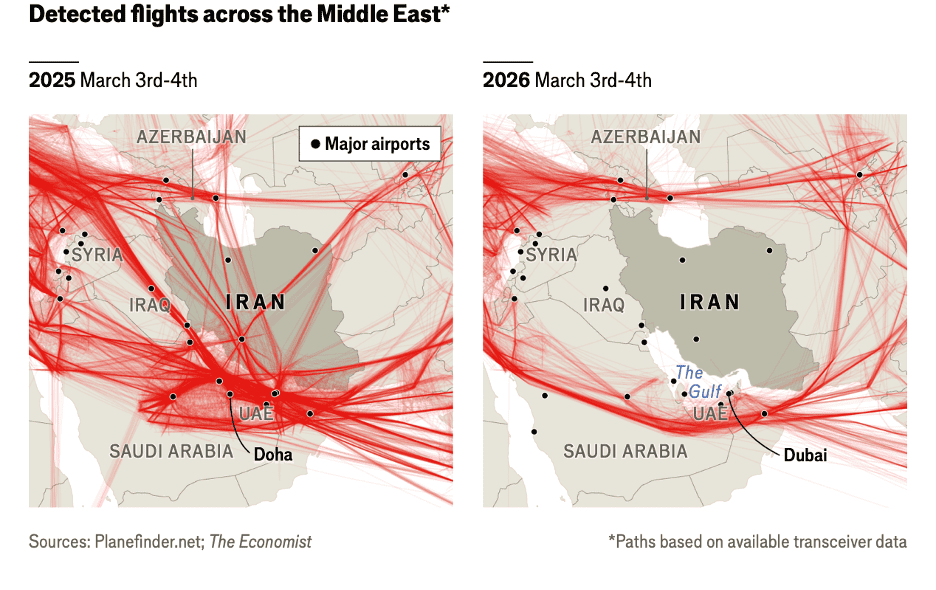
“How wars are adding hours to your flights – Visitors to the Gulf and passengers transiting through the region’s busy airports have been stranded. In March last year a typical 48-hour period saw more than 3,700 passenger planes pass over the Persian Gulf. More than half were either bound for, or departed from, Dubai in the United Arab Emirates, or Doha, Qatar’s capital. On March 3rd and 4th this year just 47 flights crossed the same stretch of sky. The most recent data, from March 11th, show around 220 departures from Dubai—roughly a third of the normal number and half of those scheduled. That same day just 16 flights departed from Doha, 5% of the average.”, The Economist, March 12, 2026
++++++++++++++++++++++++++++++++++++++++++++++++++++++++++++++++++++++++++++++++++++++++++++
Book Review
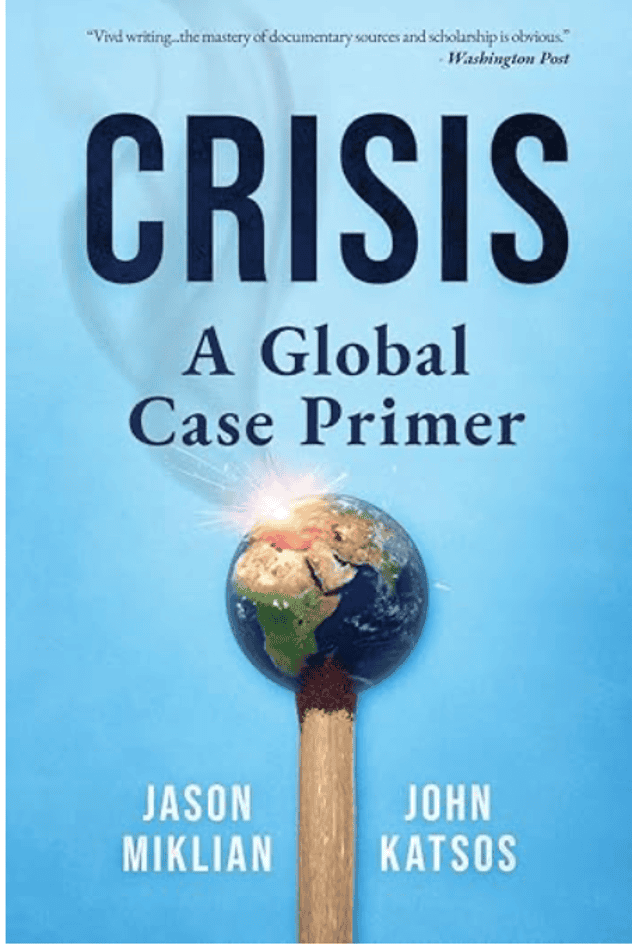
“Crisis: A Global Case Primer by Jason Miklian and John E Katsos , 2025. In a world defined by geopolitical shocks, supply-chain disruptions, pandemics, and financial volatility, Crisis: A Global Case Primer offers a timely and practical exploration of how organizations confront and sometimes survive moments of extreme uncertainty.
Rather than presenting abstract theory, the book examines a series of real-world crises across industries and countries. Each case illustrates how leaders faced rapidly evolving situations where information was incomplete, risks were cascading, and the margin for error was razor thin. The authors emphasize that crises rarely arrive in isolation. Economic pressure, political instability, reputational damage, and operational breakdowns often intersect, forcing leaders to make decisions under extraordinary stress.
One of the book’s strongest messages is that crisis management is not primarily about reaction. It is about preparation. Organizations that invest in scenario planning, resilient supply chains, and empowered leadership teams are far more capable of navigating disruption. Those that rely on rigid hierarchies or slow decision-making processes often find themselves overwhelmed when events accelerate.
For global business leaders, the book reinforces an increasingly clear reality: the operating environment of the 2020s will remain volatile. From geopolitical competition to climate shocks and technological disruption, executives must assume that crises will occur and build organizations capable of absorbing them.
The ultimate lesson is simple but powerful: resilience is now a core strategic capability.
Five Takeaways for Global Businesspeople
- Crises are inevitable — preparation determines survival.
- Speed of decision-making matters more than perfect information.
- Communication is a strategic tool during uncertainty.
- Global supply chains require redundancy and diversification.
- Leadership culture determines how organizations respond under stress.
+++++++++++++++++++++++++++++++++++++++++++++++++++++++++++++++++++++++++++++++++++++++++++

+++++++++++++++++++++++++++++++++++++++++++++++++++++++++++++++++++++++++++++++++++++++++++++
Country & Regional Updates
Argentina
“Argentina Inflation Topped Estimates Ahead of Iran War Shock – Argentina’s monthly inflation rose 2.9% in February, above the 2.8% median estimate of economists, while annual inflation accelerated to 33.1% from 32.4%. Food and non-alcoholic beverages, driven by beef, contributed the most to last month’s price increases, while housing and utilities rose the most, according to Indec. The inflation rate in March is likely to edge higher due to the fallout from the US and Israeli attacks on Iran, especially creeping gasoline and diesel prices and higher costs for fertilizers.”, Bloomberg, March 12, 2026
=============================================================================================
China
“More abundance, less prosperity: why 2 Chinas are emerging – For observers accustomed to a market economy, China’s can look like a contradiction. On the one hand, it is an unstoppable juggernaut, a manufacturing superpower with a US$1 trillion-plus trade surplus demonstrating its prowess and leverage across supply chains. China is also moving up the value chain, producing steel and widgets while also leading the world in solar panels, electric vehicles and the batteries that power them, industrial robots and more. On the other hand, the costs of this tech and export dominance are increasingly apparent. The wealth of households suffers with falling real estate values, recent graduates face a market with 17.8 per cent youth unemployment as of last summer, wages are falling, deflation is growing and an estimated 12 per cent of registered companies are “zombies”.”, The South China Morning Post, March 12, 2026
=============================================================================================
Canada
“Canada sheds more than 100,000 jobs in first two months of year – Canada’s unemployment rate rose to 6.7%, according to the latest labour figures released on Friday – the second-highest among wealthy G7 nations, behind France. February saw the sharpest drop in employment since the Covid-19 pandemic, wiping out much of the job growth recorded late last year, with the wholesale and retail trade sector taking the biggest hit. The US is by far Canada’s largest export market, leaving it especially vulnerable to American tariffs. Around three-quarters of Canadian goods were sold to the US, though that share has fallen to about 67% in recent months.”, BBC, March 13, 2026
=============================================================================================
“What would $100 oil mean for Canada? The price of West Texas Intermediate crude oil is off its highs since hitting US$120 a barrel on Monday. But traders won’t be resting easy just yet. How would Canada fare under such a scenario? The broad answer is ‘better than most countries,’ although it depends on which Canadian you ask; all relative price changes create winners and losers. The key to the outlook is the Canadian dollar. Canada’s oil exports averaged 4.3 million barrels a day over the past year, accounting for 20 per cent of total exports by value. Assuming US$100 oil prices and a modest bump in output, that figure would rise to around 25 to 30 per cent.”, The Globe and Mail, March 12, 2026
=============================================================================================
European Union
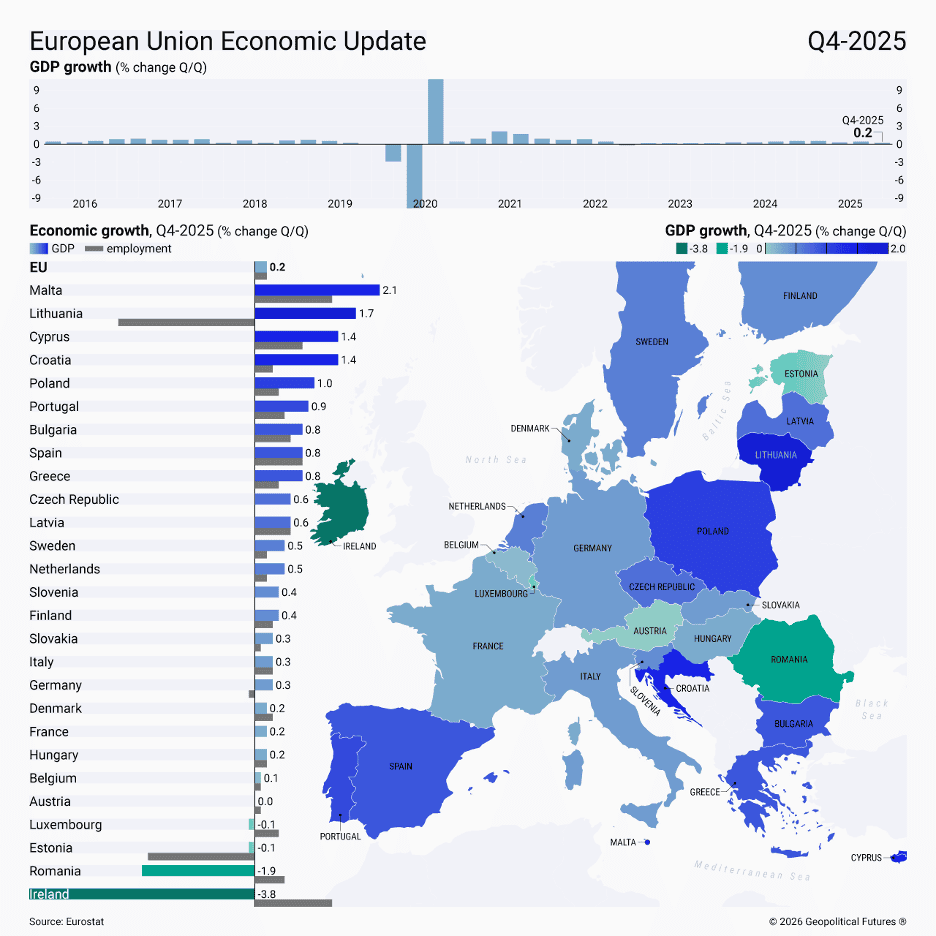
“EU Economies Can’t Catch a Break – The risk of stagflation grows if the energy squeeze continues. The European economy failed to sustain its modest momentum in the fourth quarter of 2025, with growth slowing to 0.2 percent compared with the previous quarter. The war in the Middle East has already disrupted oil and gas supplies, driving up the price of Brent crude by approximately 40 percent and pushing European gas to its highest level since January 2023.”, Geopolitical Futures, March 13, 2026
===========================================================================================
Latin America
“Meet the retail giant that’s actually beating Amazon – A $90 billion company dominant in Latin America is rapidly growing with tailored e-commerce and fintech services. Founded in 1999 in Buenos Aires, Argentina, MercadoLibre Inc. is an e-commerce and financial services company operating in 18 countries throughout Latin America, with Brazil, Mexico, and Argentina serving as its largest markets. The company faces margin challenges but maintains strong revenue growth and bullish analyst ratings. Amazon remains larger globally, expanding in AI and AWS, but also faces cost pressures and competition. Many U.S. consumers may not yet be familiar with the company, primarily because it doesn’t currently operate in the U.S. market. However, across Latin America, it has become one of the region’s most influential technology companies. Like Amazon, MercadoLibre functions as a one-stop shopping platform offering a broad range of products and services. The company emphasizes localization by adapting its marketplace to each country’s language, payment preferences, logistics, and consumer habits, an approach that helped it scale across diverse markets.”, The Street, March 12, 2026
============================================================================================
The Philippines
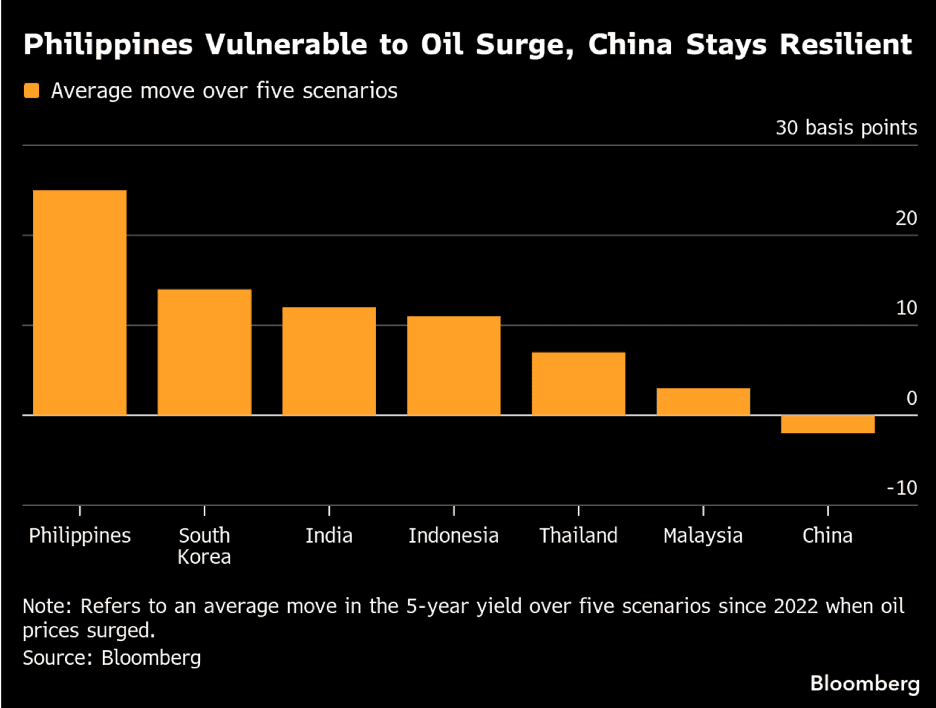
“Oil Risk Highest for Philippine Bonds in Asia, China Insulated – Peso-denominated debt has shown the highest sensitivity and the most consistent reaction to crude spikes in recent years, according to a Bloomberg analysis of five events since 2022. Rising oil prices pose a threat to many of Asia’s emerging markets. But Philippines’ consumption-driven economy is particularly vulnerable given a heavy reliance on imports, quicker transmission of fuel costs into transport and food prices, and a currency that’s trading near record lows. Meanwhile, bonds in China — the world’s largest oil importer — have fared relatively better during the oil spike episodes even as they fell Monday amid a global selloff. The nation’s authorities seek to limit the impact of surging costs through price controls, subsidies and state influence in key sectors, reducing pressure on yields.”, Bloomberg, March 10, 2026
=============================================================================================
Poland
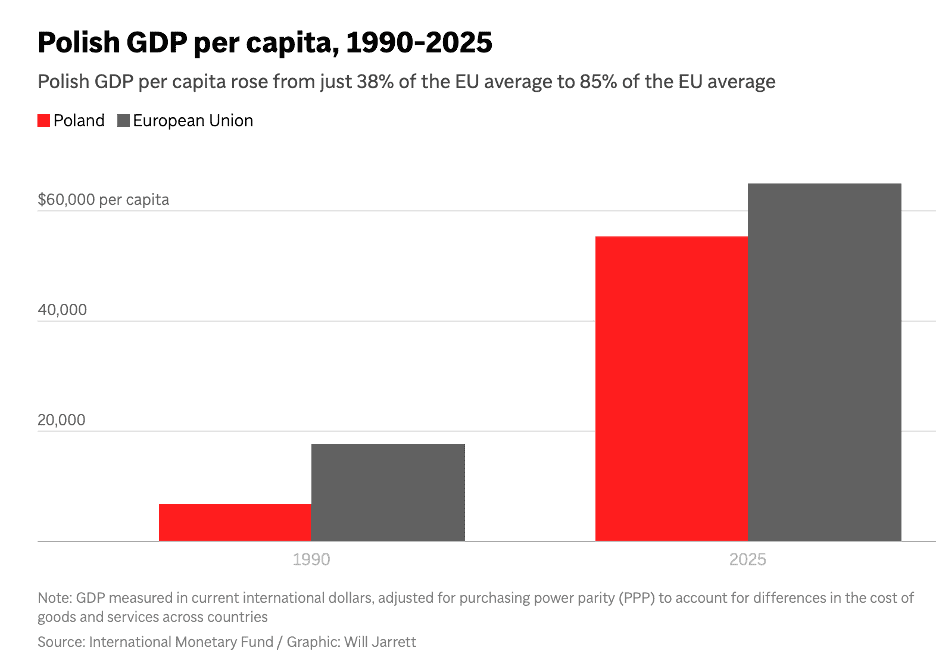
“Poland is now among the world’s 20 largest economies. How it happened – A generation ago, Poland rationed sugar and flour while its citizens were paid one-tenth what West Germans earned. Today, the economy of the country has edged past Switzerland to become the world’s 20th largest with more than $1 trillion in annual output. In 35 years — a little less than one person’s working lifetime — Poland’s per capita GDP rose to $55,340 in 2025, or 85% of the EU average. That’s up from $6,730 in 1990, or 38% of the EU average and now roughly equal to Japan’s $52,039, according to International Monetary Fund figures measured in today’s dollars and adjusted for Poland’s lower cost of living. Poland’s economy has grown an average 3.8% a year since joining the EU in 2004, easily beating the European average of 1.8%.”, AP News, March 16, 2026
Editor’s Note: I lived in Eastern Europe in 1999-2001 running a company doing business in the Czech republic, Hungary and Poland. In those days Poland was by far the poorest of the three countries. The GDP/capita of Poland was ~US$4,090 in 1999 versus US$55,340 today
============================================================================================
United Kingdom
“U.K. Economy Unexpectedly Stalled in January – GDP showed no growth, compared with a 0.1% rise in December. The U.K. economy stalled unexpectedly in January, with a sustained return to modest growth likely to be hindered further by the rise in energy prices and uncertainty that has accompanied the conflict in the Middle East. Gross domestic product showed no growth in the month, compared with a 0.1% rise in December, the Office for National Statistics said Friday. Production output slipped on month in January, while services stagnated, according to the ONS.”, The Wall Street Journal, March 13, 2026
=============================================================================================
United States
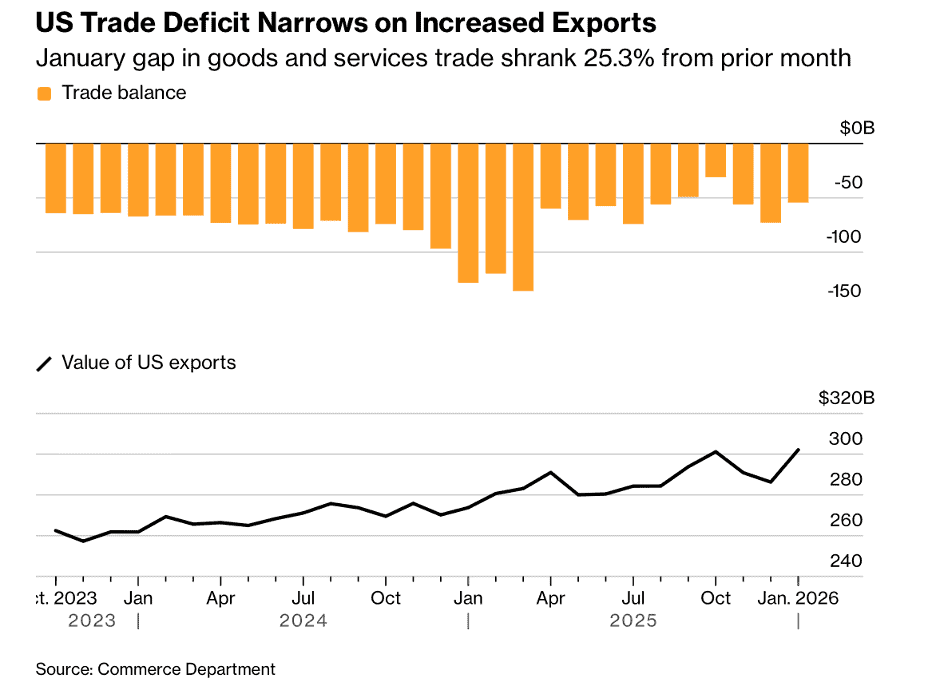
“US Trade Gap Narrowed in January by More Than Projected – The US trade deficit narrowed in January as exports increased, coming off of a turbulent year for domestic importers contending with erratic tariff policy. Exports increased 5.5% in January from the prior month, fueled by outbound shipments of nonmonetary gold and other precious metals, as well as computers and aircraft. The gap in goods and services trade shrank to $54.5 billion, with overall imports falling 0.7%, reflecting a decline in pharmaceuticals.”, Bloomberg, March 12, 2026
=============================================================================================
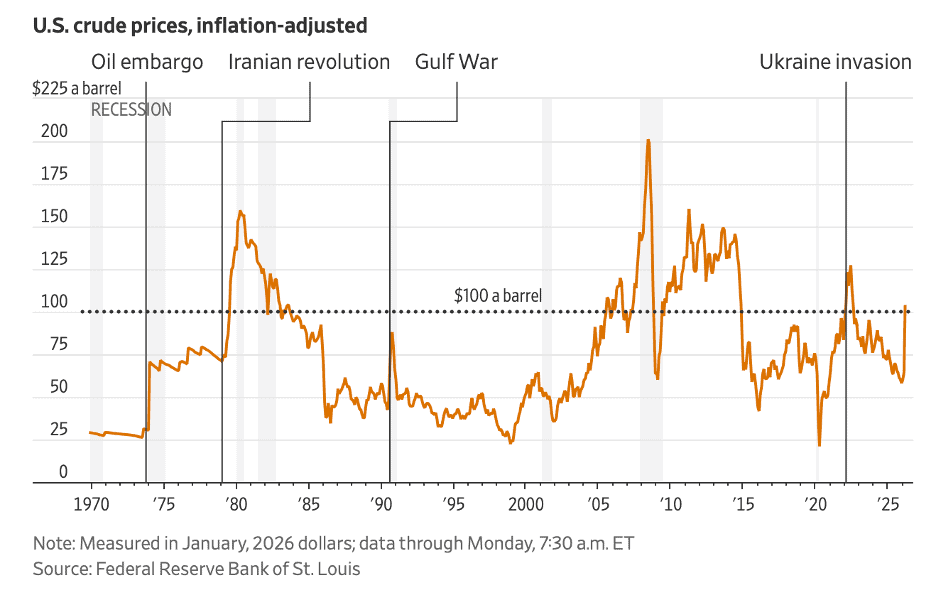
“Here’s Where the U.S. Economy Is Most Vulnerable to Iran War – Previous Mideast conflicts have caused recession. Today’s economy has more insulation from oil shock, but is showing some strains. The Middle East conflict has pushed oil prices to nearly four-year highs, increasing gasoline and diesel prices by 65 cents and $1.13 respectively. Analysts warn that costlier fuel could raise U.S. inflation and curb consumer spending, potentially slowing economic growth. Airlines and farmers face rising costs, while the average 30-year fixed mortgage rate rose to 6.11% as of March 12.”, The Wall Street Journal, March 13, 2026
============================================================================================
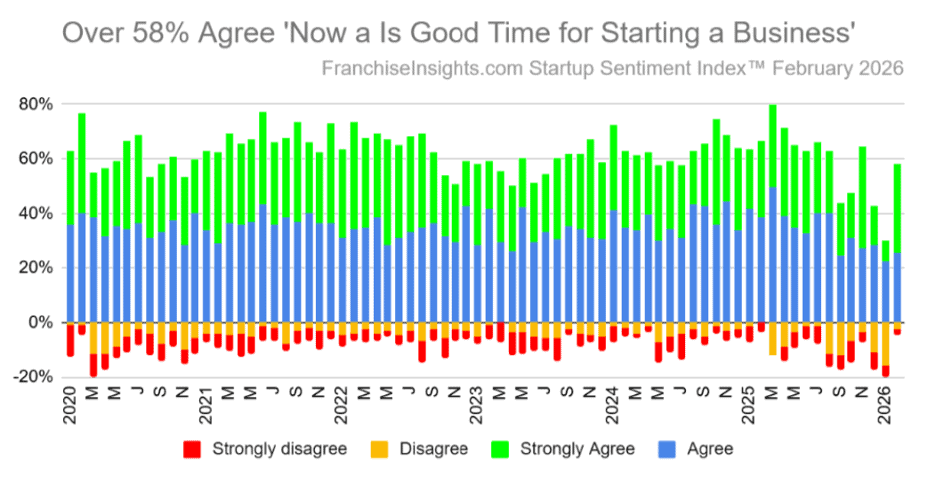
“Small Business Startup Sentiment Rebounds – Startup sentiment rebounded in February 2026 surveys as business buyer surveys showed 58.1% of persons exploring ownership agree or strongly agree that “now is a good time for startup”, up from 30% in December. This increase in sentiment about business conditions is consistent with a modest February increase in consumer confidence and revised January Conference Boardsurvey readings. In January, half (50%) of respondents “neither agreed nor disagreed” with the statement “now is a good time for starting a business”, but they were more confident in February, with less than 5% saying they “disagreed” or “strongly disagreed” with the positive sentiment. Coincidently, 58.1% of respondents say they are more likely to start a business now than three months ago.”, Franchise Insights and News, March 11, 2026
++++++++++++++++++++++++++++++++++++++++++++++++++++++++++++++++++++++++++++++++++++++++++++++

The Accredited Franchise Supplier certification
+++++++++++++++++++++++++++++++++++++++++++++++++++++++++++++++++++++++++++++++++++++++++++++
Global Brand & Franchise Sector News
“Why Private Equity Should Bet On International Franchising – Private equity (PE) has become one of the strongest growth engines in franchising. Over the past two decades, investors have helped modernize operations, drive scale, and professionalize management across dozens of leading brands. Yet one area often doesn’t receive the attention it deserves: international expansion. Some of the most successful PE investors in franchising have made acquiring the rights to franchises with international expansion a key aspect of their growth strategy. International expansion is not a distraction. It is a multiplier. It creates diversified, sustainable royalties that compound over time while up-front fees generate cash today. In the end, international expansion is not just about new markets; it’s about building a more valuable company.”, Franchising.com, March 15, 2026. This article is by your newsletter Editor, William Edwards.
===========================================================================================================
“Wendy’s plans 60 new restaurants in Mexico through partnerships – Wendy’s (WEN) currently operates 40 restaurants across Mexico, including locations in Ciudad Juarez, Chihuahua, Monterrey, and Mexico City. Wendy’s long-term goal targets 400 restaurants across the country. By comparison, McDonald’s (MCD) operates 374 restaurants, while Burger King (QSR) operates 435 restaurants across Mexico.”, Seeking Alpha, March 4, 2026
==============================================================================================
“Slim Chickens Makes Ireland Debut with First Restaurant in Dublin – Proven Multi-Unit Franchise Partners Extend Growth into a New International Market. Located in the Dundrum Town Centre, one of Ireland’s premier shopping and dining destinations, the restaurant serves as a lunch point for the brand’s entry into the Irish market and demonstrates the system’s ability to adapt to high-footfall, urban retail environments while maintain operational consistency.”, Franchising.com, February 11, 2026.
==============================================================================================
“Franchising North of the Border: Legal Realities for U.S. Brands Entering Canada – Despite recent political commentary about Canada becoming America’s 51st state, Canada remains a sovereign nation with its own legal system, judiciary, and rule of law. For U.S. businesses, this distinction matters in practical and legal terms. In contrast to the U.S., which has both federal and state-level franchise legislation, Canada regulates franchising exclusively at the provincial level.”, Franchising.com, March 13, 2026. From and article by Jennifer Shayko is a franchise lawyer with Aird & Berlis LLP.
==============================================================================================
“How to Know Your Emerging Franchise Brand is Ready for International Expansion – International expansion is one of the fastest ways to stress-test a brand. Distance, as well as cultural and legal differences, magnify every gap from support and training to documentation to unit economics. If a system isn’t truly ready, those gaps compound quickly. While each brand’s path is different, there are a few practical benchmarks and readiness signals that come up again and again.”, Franchising.com, March 13, 2026. From an article by Jason Carter, the chief operating officer of Shoot 360.
==========================================================================================
“Papa John’s Draws Fresh Takeover Interest From Qatari-Backed Fund – Irth Capital submits bid to take pizza-chain private. Irth offered to pay $47 per share for the business, the people said, which would value Papa Johns at around $1.5 billion. The offer price represents a roughly 50% premium to where Papa Johns’s shares traded before Irth’s bid was submitted, the people said. Irth, an existing shareholder in Papa Johns, recently increased its effective stake to around 10%, one of the people familiar with the matter said.”, The Wall Street Journal, March 12, 2026
============================================================================================
“The Biggest Fast Food Chain In The World Is One You’ve Probably Never Heard Of – Move over, McDonald’s. Mixue Ice Cream & Tea, headquartered in China, has more locations than any other chain in the world, with more than 45,000 outposts. The brand is known for affordable soft-serve ice cream, teas, and other beverages. If its Chinese name, Mixue Bingcheng (which translates to honey snow ice city), doesn’t ring a bell, get ready for a frosty introduction. The beloved brand is known for soft-serve ice cream cones starting at just $1.19 and for teas and other beverages starting at $1.99. Its affordability is one of the biggest drivers of its mass appeal.”, Delish, March 10, 2026
================================================================================================
“Shell to Sell Jiffy Lube to Monomoy in $1.3 Billion Deal – The sale includes the Jiffy Lube brand, franchisee Premium Velocity Auto and a network of stores owned and operated by independent franchisees. Jiffy Lube has more than 2,000 locations. Shell said it is “capitalizing on a strong market opportunity.” It said the divestment allows it to monetize an asset that isn’t central to its lubricants portfolio in the U.S. and reinvest in higher-return opportunities. Jiffy Lube makes up 6.5% of the volume of Shell’s U.S. and Canada total lubricants business.”, The Wall Street Journal, March 10, 2026
============================================================================================
“Gong cha buys 170 US stores from master franchisee – The purchase will help the bubble tea brand strengthen its U.S. system and ultimately speed up growth as it targets 1,000 units in the country. Gong cha recently announced an overhaul of its store model and operations that includes a new automated drink-making platform that cuts prep time for drinks by roughly a minute, the company said in a separate press release. This technology could help it take advantage of the expanding cold beverage market in the U.S. ‘Bringing this territory in-house allows us to further sharpen our development strategy and strengthen support for our franchise partners,’ said Geoff Henry, the company’s president for the Americas.”, Restaurant Dive, March 9, 2026
++++++++++++++++++++++++++++++++++++++++++++++++++++++++++++++++++++++++++++++++++++++++++++++
To receive our biweekly newsletter in your email every other Tuesday, click here – https://insider.edwardsglobal.com
+++++++++++++++++++++++++++++++++++++++++++++++++++++++++++++++++++++++++++++++++++++++++++++++
Our Mission, Information Sources & Who We Are
Our biweekly global business update newsletter focuses on what is happening around the worldthat impacts new trends, health, consumer spending, business investment, the franchise sector, economic development, and travel. We daily monitor 30+ countries, 40+ international information sources and six business sectors to keep up with what is going on in this ever-changing business environment. And our GlobalTeam on the ground covering 25+ countries provide us with updates about what is actually happening in their specific countries. We do not get involved in or report on politics!
+++++++++++++++++++++++++++++++++++++++++++++++++++++++++++++++++++++++++++++++++++++++++++
William “Bill” Edwards: CEO & Global Trade Advisor “Is Uniquely Qualified to Steer Sr. Executives Successfully Through the Complex Waters of Going Global”. With five decades of successful international business experience spanning virtually every corner of the world and many business sectors, Bill Edwards understands the global business landscape like no other. He has been a County Master Franchisee in five countries in Asia, Europe, and the Middle East; the Senior VP for a franchisor operating in 15 countries and a full-service global management consultant since 2001 helping 40+ franchisors expand into new countries. Bill knows how to turn the challenges in taking a brand global into opportunities.

For a complimentary 30-minute consultation on how to take your business into new countries successfully. For a complimentary call with Bill Edwards click on the QR code or contact Bill at bedwards@edwardsglobal.com and +1 949 375 1896
And download our latest chart ranking 40+ countries as places to do business, used by many companies for strategic planning, at this link: