
“It always seems impossible until it’s done.”
Welcome to the 154th Edition of the Biweekly Global Business Update – The above quotation is attributed to Nelson Mandala and sees appropriate as we plan for doing global business in 2026. As we move deeper into 2026, the signals coming from global markets are both clear and complex. In this edition we cover China, India, Japan, Taiwan, the United Arab Emirates, the United Kingdom and the United States.
Global power demand is accelerating alongside AI infrastructure buildout. Fertility rates continue to decline across developed economies. Trade frameworks remain fluid. The world’s largest economies are widening their scale advantage, while cost-of-living pressures persist in major urban centers.
For global business leaders, this is not a moment for reaction — it is a moment for disciplined positioning.
In this edition, we analyze the 2026 Global Cost of Living Index and what it signals for talent mobility, compensation planning, and location strategy. We review the world’s 50 largest economies by projected GDP and examine how output concentration is reshaping competitive dynamics. We explore the accelerating “Age of Electricity” and the implications of surging power demand for data centers, manufacturing siting, and national industrial policy. We assess evolving tariff structures, shifting trade alignments, and regulatory adjustments that are quietly influencing cross-border capital flows.
In the franchise sector, we review global restaurant expansion trends, cross-border brand movement, and the implications of shifting consumer spending patterns in both emerging and mature markets. As labor costs, urban density, and middle-class growth diverge by region, franchisors must align market selection, capital deployment, and local operating partnerships with greater precision than ever before.
This edition’s book review highlights: “Blue Ocean Strategy, Expanded Edition: How to Create Uncontested Market Space and Make the Competition Irrelevant” by W. Chan Kim , Renée A. Mauborgne and Renee Mauborgne. More than a decade after its original release, Blue Ocean Strategy remains one of the most influential strategy books in global business. In the Expanded Edition, W. Chan Kim and Renée Mauborgne refine and reinforce their central thesis: companies achieve breakthrough growth not by battling competitors in crowded ‘red oceans,’ but by creating uncontested market space — ‘blue oceans’ — where competition becomes irrelevant.
++++++++++++++++++++++++++++++++++++++++++++++++++++++++++++++++++++++++++++++++++++++++++++++
To receive our biweekly newsletter by email every other Tuesday, click here https://insider.edwardsglobal.com
+++++++++++++++++++++++++++++++++++++++++++++++++++++++++++++++++++++++++++++++++++++++++++++
The mission of this newsletter is to use trusted global and regional information sources plus our network of 20+ in-country Associates to update our global readers on key global and local trends that can impact the success of their businesses at home and abroad. We subscribe to about 40 international information sources to keep our readers up to date on the world’s business. We do not get involved with or report on politics!
PLEASE NOTE: Some of the information sources that we provide links to in our newsletter require a paid subscription to directly access them. Clicking on a link may not give the reader access to the content.
Edited and curated by: William (Bill) Edwards, CEO & Global Business Advisor, Edwards Global Services, Inc. (EGS), Irvine, California, USA. Contact Bill with questions, comments and contributions. Bedwards@edwardsglobal.com, +1 949 375 1896
Link to our current and past newsletters: https://edwardsglobal.com/geowizard/
+++++++++++++++++++++++++++++++++++++++++++++++++++++++++++++++++++++++++++++++++++++++++
First, A Few Words of Wisdom From Others For These Times
“It always seems impossible until it’s done.”, often attributed to Nelson Mandela
“Happiness depends more upon the internal frame of a person’s own mind than on the externals in the world”, 1st US President, George Washington
“The greatest danger in times of turbulence is not the turbulence; it is to act with yesterday’s logic.”, Peter Drucker
+++++++++++++++++++++++++++++++++++++++++++++++++++++++++++++++++++++++++++++++++++++++++++
Highlights in issue #154:
The Global Cost of Living Index 2026
The World’s 50 Largest Economies by GDP in 2026
Full-service restaurants led industry’s job growth in 2025 –
For Better or Worse, Health Care Is America’s Employment Engine
Japan’s Economy Ekes Out Anemic Growth as Takaichi Eyes Spending
Franchise Global News Section: Bob Evans®, Krispy Kreme®, McDonalds®, TGI Fridays® and Wendy’s®
++++++++++++++++++++++++++++++++++++++++++++++++++++++++++++++++++++++++++++++++++++++++++++
Interesting Data, Articles and Studies
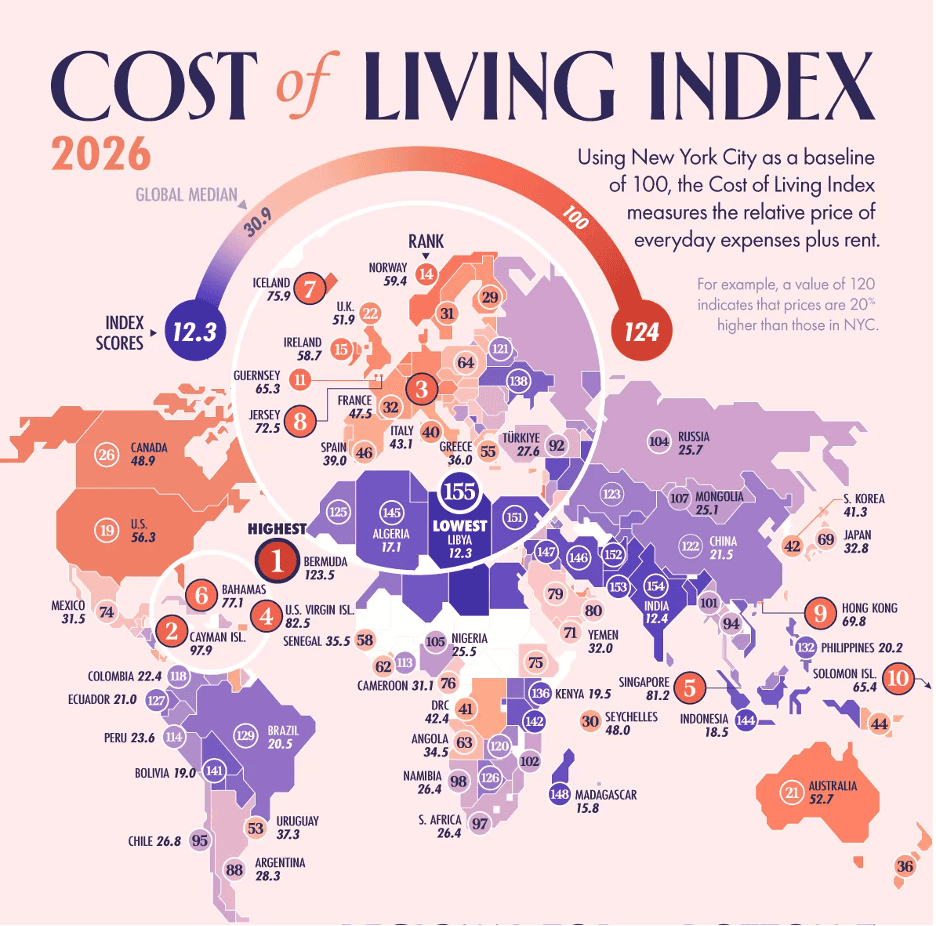
“The Global Cost of Living Index 2026 – Bermuda is the most expensive place to live in the world in 2026, with prices 23.5% higher than New York City. Switzerland leads Europe, while Singapore is the most expensive in Asia. This graphic visualizes Numbeo’s Global Cost of Living Index, which measures the price of everyday expenses, including rent, relative to New York City (baseline of 100). If a country has an index score of 80, prices are 20% lower than in New York. Scores above 100 indicate higher everyday costs. While inflation has eased in many regions, the cost of living remains a major global challenge. Across 28 countries, home prices have risen more than 50% since 2020, and grocery costs have risen sharply in countries such as Mexico, Germany, and Malaysia, continuing to strain household budgets worldwide.”, Visual Capitalist & Numbeo, February 9, 2026
===============================================================================================
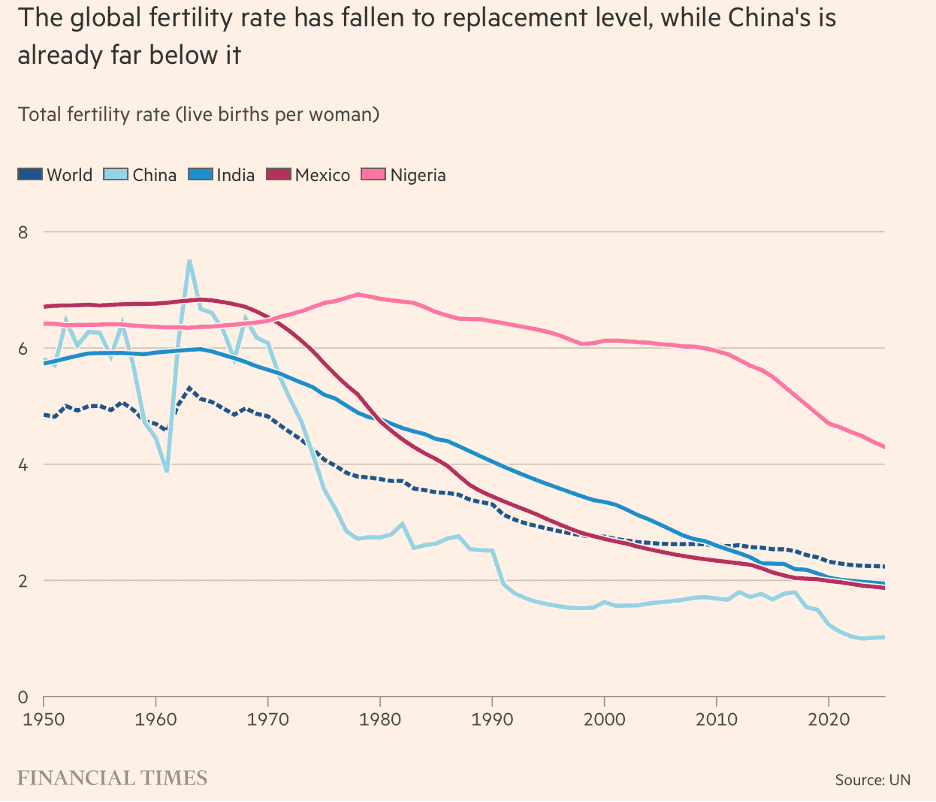
“Why are fertility rates collapsing? Gender roles. A big part of female graduates’ decision to have children depends on how they expect their husbands to behave. The decline in fertility has occurred in almost every country in the world. Humanity is unprecedentedly well off and yet has far fewer children relative to its numbers than before. Quality children are expensive everywhere, but in some countries they are exorbitantly so. Please use the sharing tools found via the share button at the top or side of articles. Gender norms will need to be even more equal and societal help with the costs of children even greater if there is to be much hope of raising fertility rates. But a big rise seems unlikely. A declining population looks inevitable in a huge number of rich countries, if mass immigration is ruled out.”, The Financial Times, February 10, 2026
============================================================================================
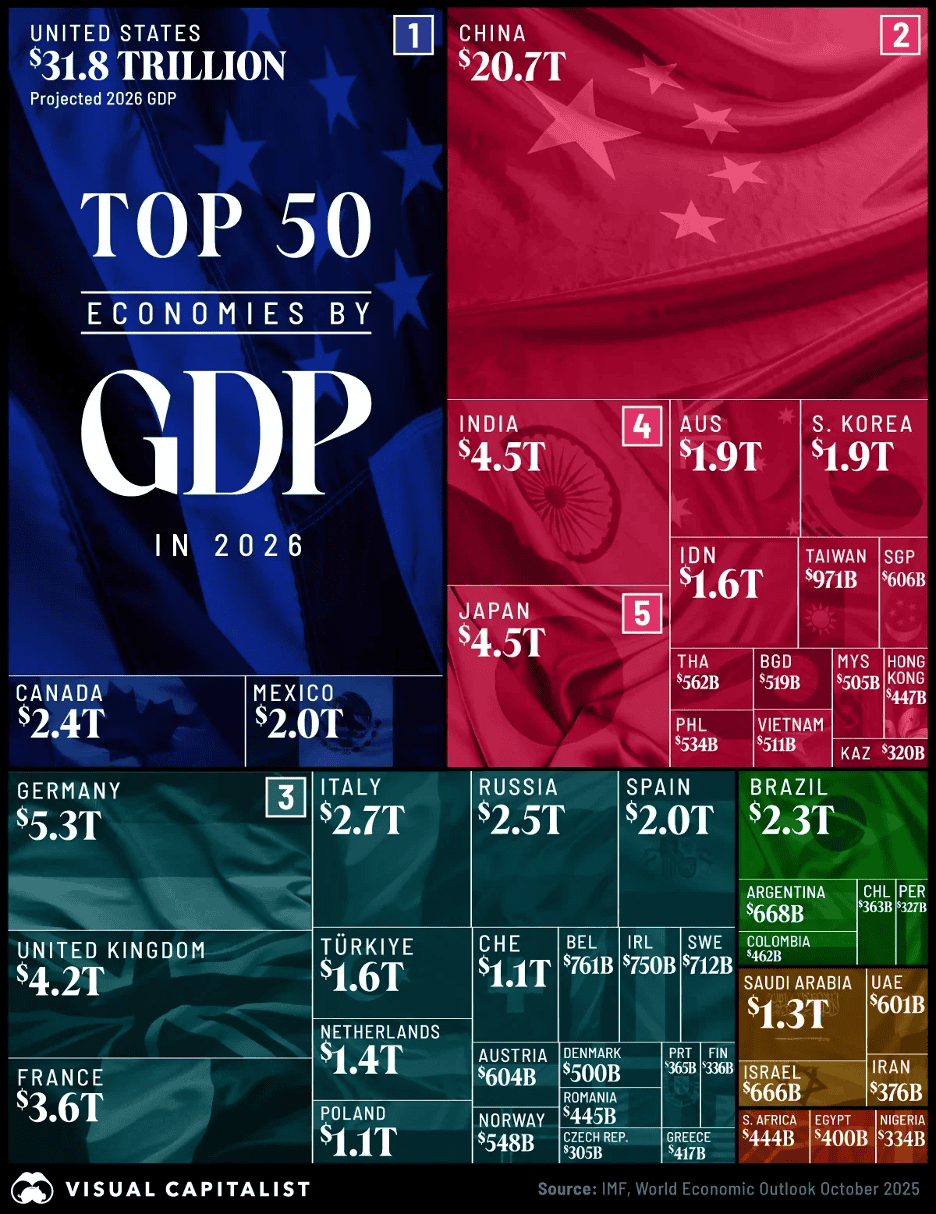
“The World’s 50 Largest Economies by GDP in 2026 – This infographic ranks the world’s 50 largest economies by projected nominal GDP in 2026, based on data from the IMF’s World Economic Outlook (October 2025). The global economy is projected to reach $123.6 trillion in 2026. The United States remains the world’s largest economy, accounting for over $31.8 trillion in GDP. The top five economies generate more than 55% of global economic output.”, Visual Capitalist & the International Monetary Fund, January 29, 2026
===============================================================================================
“Global AI Battle Turbocharged by 50% Power Demand Surge – Governments have only begun to grasp the major shifts in policies and politics the “age of electricity” may bring. In a Davos presentation last month, the Nvidia Corp. boss unveiled his vision of the artificial intelligence buildout in the form of a “five-layer cake.” Near the top is where economic value is created, via the models that drive AI and the applications that make it work for businesses. But the base layer – the sponge in the cake — is energy. Right now that means electricity, with power-hungry data centers springing up around the world to drive the new technology. Those centers are effectively competing with humans, who of course rely on electric power to heat and cool their homes and increasingly to get around in cars or trains. The obvious conclusion is, we’re going to need a lot more of it. That’s also the key finding of the new annual report on power production and markets by the International Energy Agency – which heralds the dawning of an “Age of Electricity.” In the coming five years, the IEA predicts global demand for power is set to grow roughly 50% faster than it did during the previous decade – and more than twice as fast as energy demand overall.”, Bloomberg, February 14, 2026
+++++++++++++++++++++++++++++++++++++++++++++++++++++++++++++++++++++++++++++++++++++++++++++++
Global Supply Chain, Energy, Commodities, Inflation, Taxes, Tariffs & Trade Issues
“Donald Trump plans to roll back tariffs on metal and aluminium goods – Latest softening of levies comes amid persistent voter anxiety about affordability in US. The US president hit steel and aluminium imports with tariffs of up to 50 per cent last summer, and has expanded the taxes to a range of goods made from those metals including washing machines and ovens. But his administration is now reviewing the list of products affected by the levies and plans to exempt some items, halt the expansion of the lists and instead launch more targeted national security probes into specific goods, according to three people familiar with the matter. The people said trade officials in the commerce department and US trade representative’s office believed the tariffs were hurting consumers by raising prices for goods such as pie tins and food and drink cans. Trump’s tariff blitz has pushed US duties to their highest level since before the second world war.”, The Financial Times, February 13, 2026
===============================================================================================
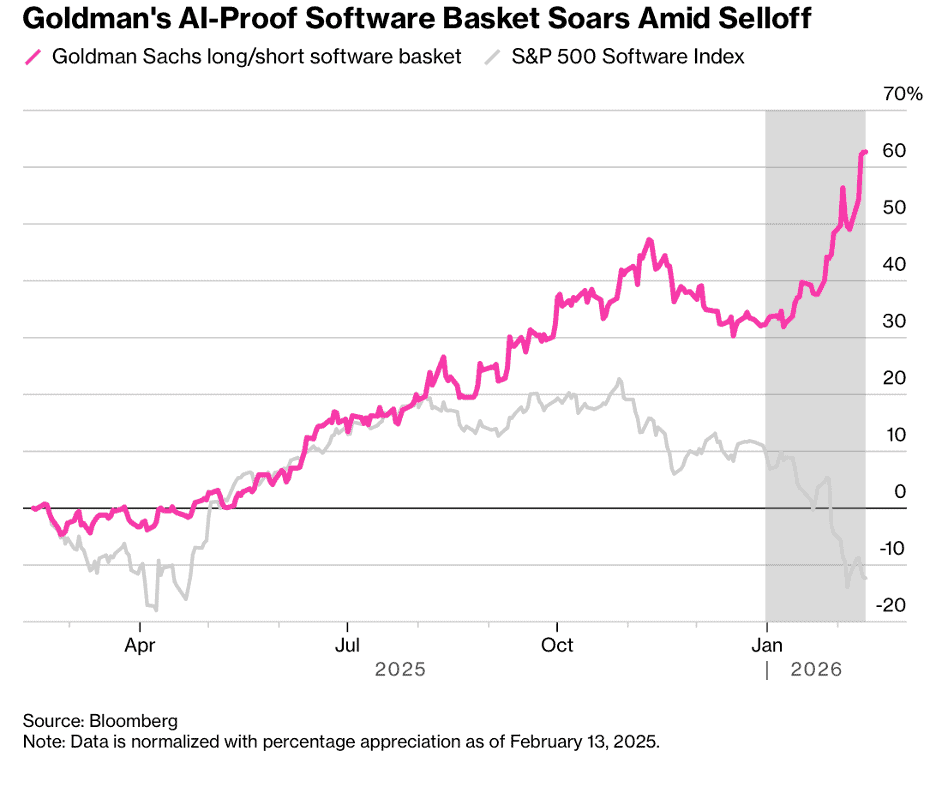
“Goldman Traders Launch AI-Proof Software Basket Amid Sector Rout – Goldman Sachs Group Inc. has introduced a software pair trade basket that goes long companies whose businesses are seen as difficult for AI to displace and shorts firms whose workflows AI could automate or replicate internally. The basket includes companies such as Cloudflare Inc., CrowdStrike Holdings Inc., and Microsoft Corp. on the long side, and Monday.com Ltd., Salesforce Inc., and Duolingo Inc. on the short side. The launch comes as anxiety over AI’s disruptive potential intensifies, with software stocks trading at about 27 times earnings, down from roughly 51 times earnings a year ago, and earnings expectations remaining broadly intact.”, Bloomberg, February 13, 2026
============================================================================================
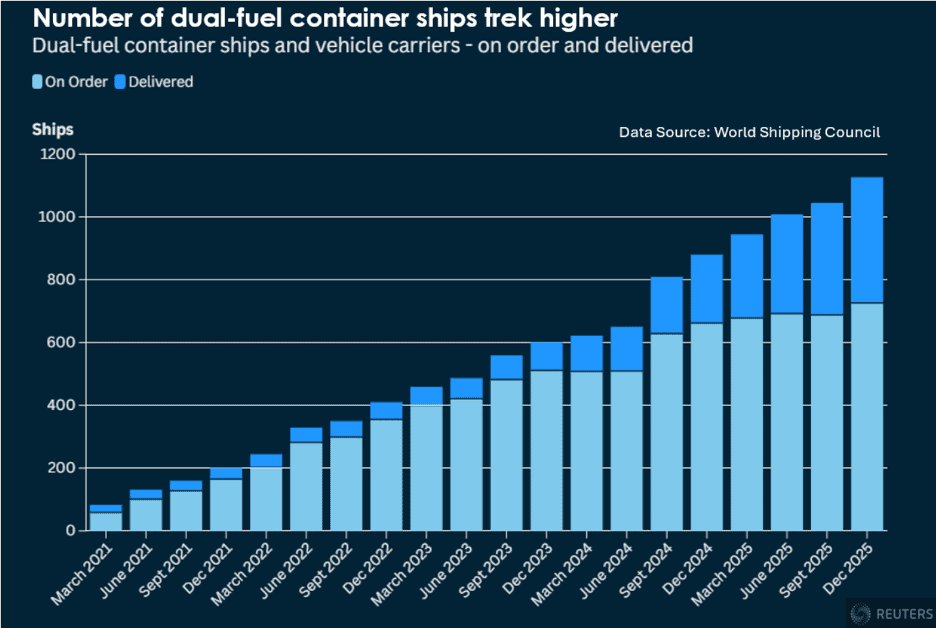
“Global shipping industry sticks with green investments, despite carbon price delay – Shipping accounts for nearly 3% of greenhouse gas emissions. he shipping industry’s biggest players are shrugging off Trump administration opposition to a global carbon price and are forging ahead with billions of dollars in emissions-reducing investments, according to company officials and a Reuters analysis of data. Europe, Brazil and a host of other nations are pushing the sector, which is responsible for nearly 3% of the world’s greenhouse gas emissions, to go green. But, in October, the U.S. and Saudi Arabia, the world’s two largest oil producers, successfully spearheaded efforts to postpone by one year a decision on the International Maritime Organization’s proposal of a $380-per-metric-ton levy.”, Reuters, February 12, 2026
+++++++++++++++++++++++++++++++++++++++++++++++++++++++++++++++++++++++++++++++++++++++++++++++
Global & Regional Travel News
“3 US Carriers Included In The World’s 25 Safest Airlines For 2026 – A “recently released report on the world’s 25 safest full-service airlines for 2026 included Alaska Airlines, Delta Air Lines, and American Airlines. “Dubbed No. 1 on the list of this year’s safest full-service airlines was Etihad Airways. Notably, the latter is one of the United Arab Emirates (UAE)’s two official flag carriers. The country’s other national airline, Emirates, ranked fifth. Cathay Pacific (Hong Kong) ranked second on the list of the world’s safest airlines in 2026. It was followed by Qantas (Australia) in third and Qatar Airways (Qatar) in fourth.”, Travel Noire, February 13, 2026
++++++++++++++++++++++++++++++++++++++++++++++++++++++++++++++++++++++++++++++++++++++++++++
Book Review
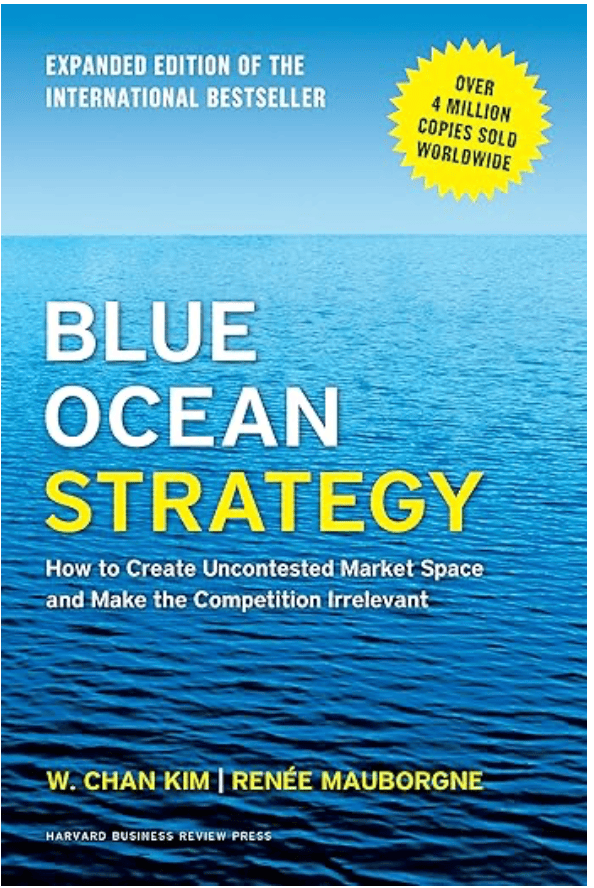
“Blue Ocean Strategy, Expanded Edition: How to Create Uncontested Market Space and Make the Competition Irrelevant” by W. Chan Kim , Renée A. Mauborgne and Renee Mauborgne. More than a decade after its original release, Blue Ocean Strategy remains one of the most influential strategy books in global business. In the Expanded Edition, W. Chan Kim and Renée Mauborgne refine and reinforce their central thesis: companies achieve breakthrough growth not by battling competitors in crowded ‘red oceans,’ but by creating uncontested market space — ‘blue oceans’ — where competition becomes irrelevant.
The authors challenge the traditional assumption that strategy is about outperforming rivals. Instead, they argue that lasting growth comes from value innovation — simultaneously increasing buyer value while reducing costs. Through case studies ranging from Cirque du Soleil to Nintendo and emerging-market innovators, the book demonstrates how redefining industry boundaries can unlock new demand rather than fight over existing customers.
The Expanded Edition adds updated case examples and deeper guidance on execution risks, organizational alignment, and the human side of transformation — areas often overlooked in strategy discussions. Importantly, Kim and Mauborgne emphasize tools, not just theory. The Strategy Canvas and Four Actions Framework provide practical, visual methods for rethinking competitive positioning.
For global business leaders navigating saturated markets, geopolitical uncertainty, and margin pressure, Blue Ocean Strategy is not simply about innovation. It is about disciplined differentiation and strategic courage. In a world obsessed with benchmarking competitors, this book reminds leaders to step back and ask a more powerful question: What if we changed the game entirely?
Five Takeaways for Global Business Leaders
- Competing harder is not the same as competing smarter. Growth often comes from redefining the market, not dominating it.
- Value innovation drives durable advantage. Raise what matters to customers while eliminating or reducing what does not.
- Noncustomers matter. Expanding demand beyond current buyers can unlock global growth.
- Strategy must be visual and simple. Tools like the Strategy Canvas clarify trade-offs and sharpen decision-making.
- Execution risk is cultural. Organizational resistance, not idea scarcity, is the biggest obstacle to blue ocean moves.
+++++++++++++++++++++++++++++++++++++++++++++++++++++++++++++++++++++++++++++++++++++++++++

+++++++++++++++++++++++++++++++++++++++++++++++++++++++++++++++++++++++++++++++++++++++++++++
Country & Regional Updates
China
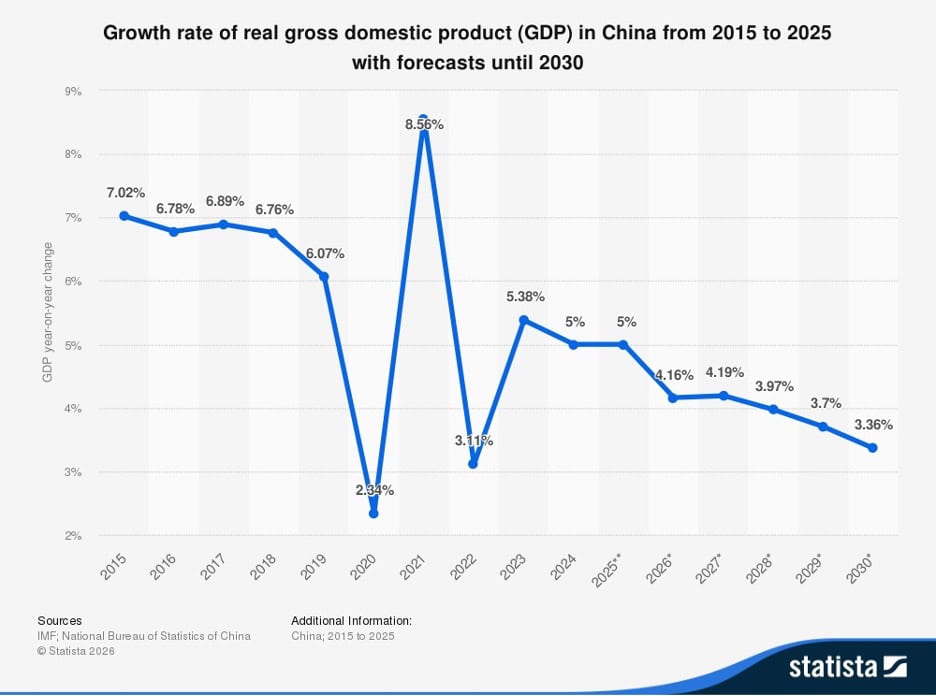
“Gross domestic product (GDP) growth rate in China 2015-2030 – As of 2024, China was among the leading countries with the largest gross domestic product worldwide, second only to the United States which had a GDP volume of almost 29.2 trillion U.S. dollars. The Chinese GDP has shown remarkable growth over the past years. Upon closer examination of the distribution of GDP across economic sectors, a gradual shift from an economy heavily based on industrial production towards an economy focused on services becomes visible, with the service industry outpacing the manufacturing sector in terms of GDP contribution. According to preliminary figures, the growth of real gross domestic product (GDP) in China amounted to 5.0 percent in 2025. For 2026, the IMF expects a GDP growth rate of around 4.2 percent.”, Published for Statista by C. Textor, Jan 19, 2026
=============================================================================================
India
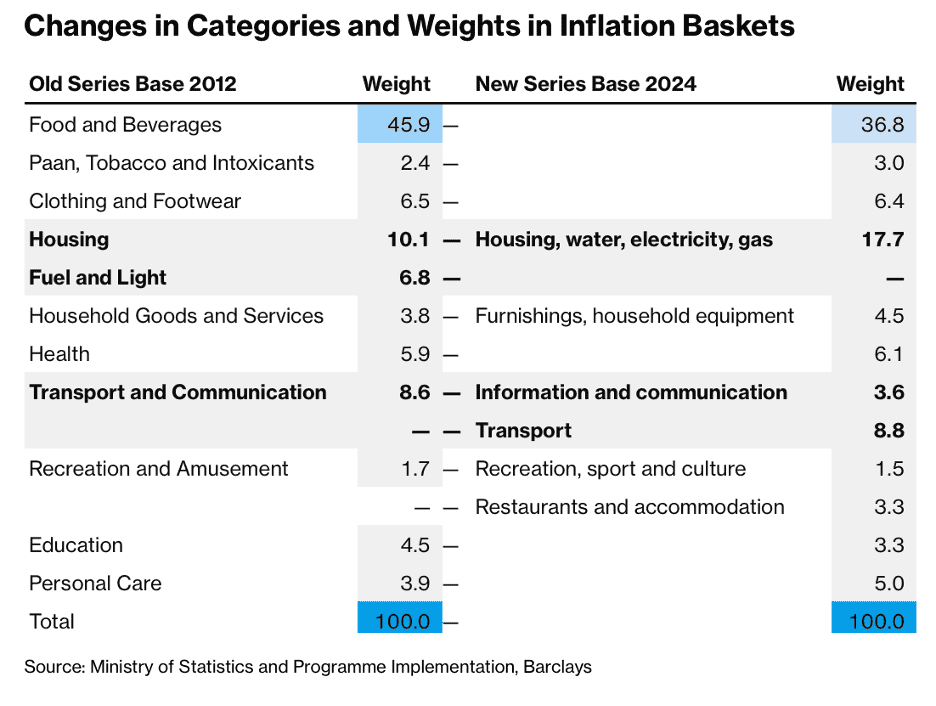
“India’s New CPI May Give Central Bank Reason to Stay on Hold – India will publish inflation figures based on a new index, which may show elevated price pressures in the economy, giving the central bank reason to keep interest rates on hold. The new consumer price index will reflect changes in spending patterns since the last overhaul, with the weighting of volatile items such as food reduced and new spending categories like rentals for rural housing and online shopping added. The changes could lift the January inflation reading and prompt the central bank to hold off on any further rate cuts, potentially pushing up bond yields further and influencing financial market participants’ expectations for interest rates.”, Bloomberg, February 11, 2026
=============================================================================================
Japan
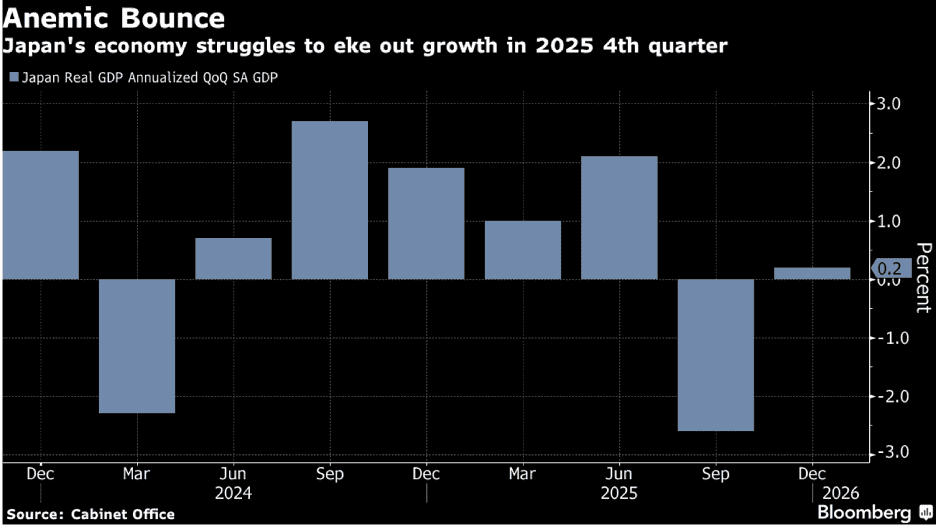
“Japan’s Economy Ekes Out Anemic Growth as Takaichi Eyes Spending – Japan’s economic output in the fourth quarter of 2025 was much weaker than expected, registering anemic growth after a deep contraction in the previous period, underscoring the case for Prime Minister Sanae Takaichi’s proactive spending policies following her election triumph. Japan’s real gross domestic product grew 0.2% on an annualized basis in the three months through December, according to a Cabinet Office report Monday. That was weaker than economists’ median estimate of 1.6% growth. Consumer spending, the biggest component of GDP, grew 0.1%, showing the fragility of domestic demand as households continue to cope with inflation that hovered above the Bank of Japan’s 2% target for four years through 2025.”, Bloomberg, February 15, 2026
============================================================================================
Singapore
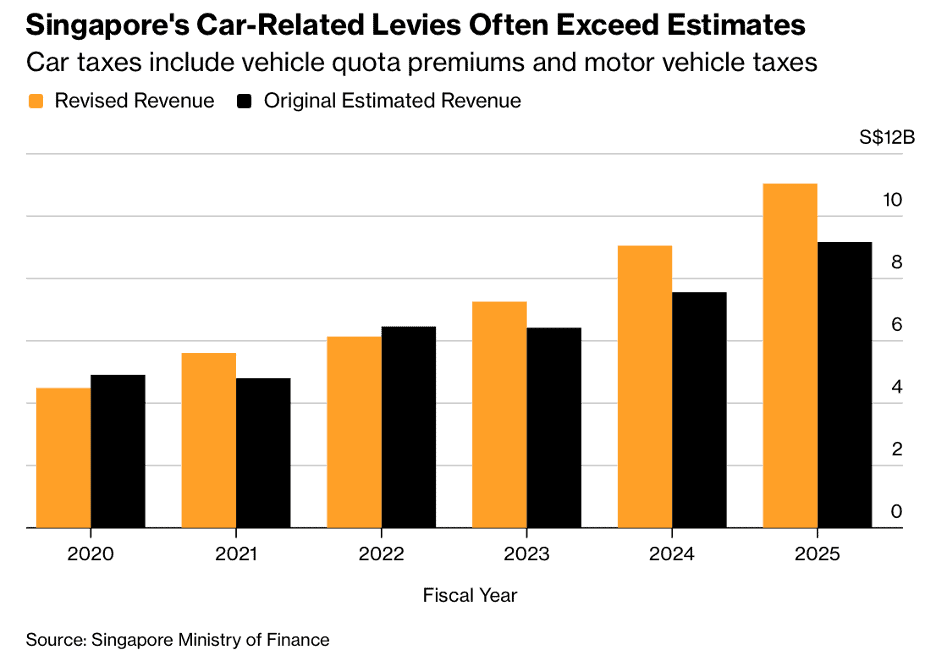
“Singapore’s Car Tax Revenue Now So High It Exceeds Fiji’s GDP – “Vehicle quota premiums raisedS$8.66 billion ($6.9 billion) in the year ending March 2026, about 31% more than the government initially estimated a year ago. When combined with motor vehicle taxes, it brings the total to S$11.05 billion — an amount greater than the annual gross domestic product of Fiji. The government projects that vehicle quota premiums and motor vehicle taxes will raise a combined S$12.22 billion in the year ending March 2027. Singapore has a unique system for allowing cars to stay on the road. Every vehicle must be granted a Certificate of Entitlement as part of a bidding process, which grants permission for it to be driven for a maximum of 10 years.”, Bloomberg, February 13, 2026
===========================================================================================
Taiwan
“U.S.-Taiwan Trade Agreement Leaves Major Questions Open – The U.S.-Taiwan Reciprocal Trade Agreement should provide welcome stability to bilateral economic ties, but differences over the trade balance, semiconductor manufacturing, and currency intervention will remain. Taiwan has become only the seventh U.S. trading partner to reach a Reciprocal Trade Agreement with the Trump administration. Under the terms of the deal, the United States will reduce the reciprocal tariff rate on Taiwanese goods to 15 percent, Taiwan will reduce tariffs and non-tariff barriers, Taiwanese firms will invest at least $250 billion in the United States for semiconductor production, and Taiwan will guarantee $250 billion in credit for these companies. Taiwan also committed to increasing its purchases of American products, including $44.4 billion of liquefied natural gas and crude oil, $15.2 billion of aircraft and engines, and $25.2 billion of power-generation equipment.”, Council on Foreign Relations, February 12, 2026
============================================================================================
United Arab Emirates
“UAE ‘surpassing Hong Kong’, challenging Singapore for global trade crown – With non-oil trade nearly doubling, analysts say the UAE has secured a first-mover advantage that leaves regional rivals trailing behind. Driven by an aggressive post-pandemic strategy of “economic statecraft,” the nation’s non-oil trade reached $1.03 trillion in 2025, hitting its 2031 targets six years ahead of schedule. By maintaining a non-aligned stance that balances Western partnerships with a role as a hub for diverse capital flows, the UAE has attracted significant global investment and talent. Dubai-based DP World now rivals Hong Kong’s Hutchison Ports and is positioned to challenge Singapore’s PSA International for global leadership in port operations. Beyond logistics, the UAE is investing heavily in AI to secure a first-mover advantage in the next frontier of trade technology.”, South China Morning Post, February 14, 2026
=============================================================================================
United Kingdom
“UK labour reforms to cut hiring by one in three employers, survey shows – “More than one in three UK employers plan to cut their hiring of permanent staff due to costs introduced by the government’s labour law reforms, a survey showed on Monday. The Chartered Institute of Personnel and Development, a professional body for the human resources sector, said overall hiring intentions remained at their lowest level on record excluding the first year of the COVID pandemic, adding to the risks that an ongoing jobs market slowdown deepens.”, Reuters, February 16, 2026
============================================================================================
United States
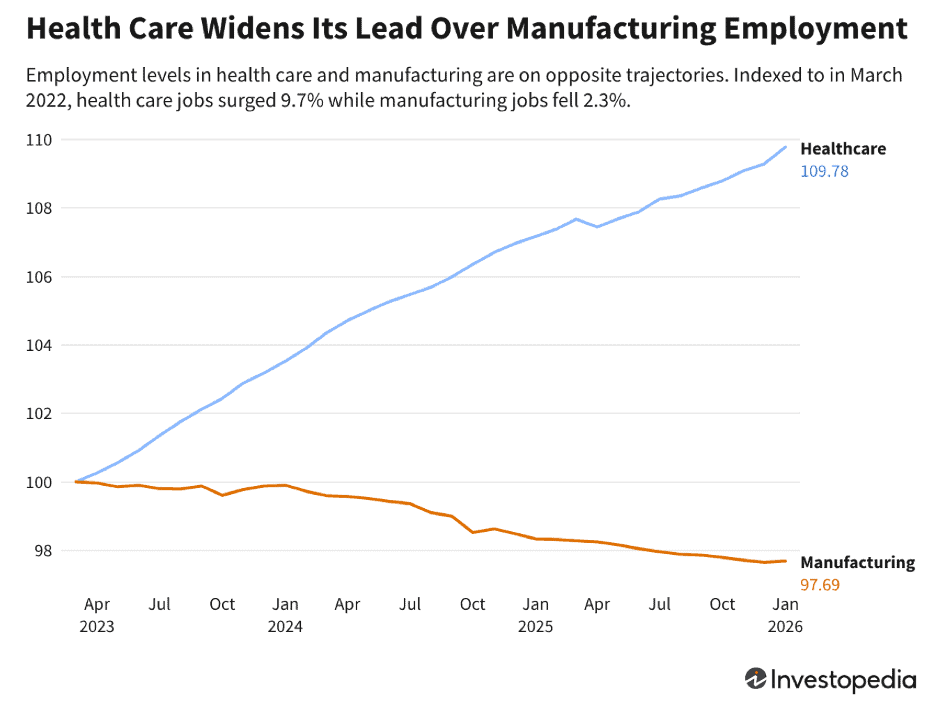
“For Better or Worse, Health Care Is America’s Employment Engine – Off The Charts: The Visual Says It All. “Manufacturing, once the largest employer in the U.S. economy, has shed jobs consistently since 2022. Health care has gained them. The two sectors have been on opposite trajectories since 2008, when health care employment first exceeded manufacturing. As of January, more than 18 million people worked in health care, compared to 12 million in manufacturing, according to the Bureau of Labor Statistics. And those two sectors have been headed in opposite directions in recent years.”, Investopedia, February 13, 2026
+++++++++++++++++++++++++++++++++++++++++++++++++++++++++++++++++++++++++++++++++++++++++++

The Accredited Franchise Supplier certification
+++++++++++++++++++++++++++++++++++++++++++++++++++++++++++++++++++++++++++++++++++++++++++++
Global Brand & Franchise Sector News
“How Franchise Economics Can Fuel YUM’s Next Growth Cycle – Yum! Brands is making franchise “What Franchisors Need to Get Right Before Expanding Internationally – International expansion is a milestone. It’s proof that a franchise system has “made it” at home, and there’s enough demand for your brand to start growing beyond its borders. But, going global isn’t about planting flags on a map. It’s about discipline, clarity, and an honest understanding of what makes your concept work, and what doesn’t translate automatically across borders. Not every successful domestic franchise is suited for international expansion.”, Franchising.com, February 13, 2026. This article is by Stephen P. Smith who is the founder & CEO of Hotworx.
=============================================================================================
“Full-service restaurants led industry’s job growth in 2025 – The segment added a net 55,000 jobs during the year, however, it remains below pre-pandemic levels…..eating and drinking establishments added a net 27,800 jobs in January on a seasonally-adjusted basis, up from 13,900 jobs in December. January marked the eighth consecutive monthly increase in restaurant employment, according to the National Restaurant Association. In the last eight months, eating and drinking places added a net 172,000 jobs, versus the overall economy, which has added just 129,000 jobs. The association notes that the industry’s recent employment trends suggest that many operators continue to prioritize boosting staffing levels, even amid a challenging business environment.”, Nation’s Restaurant News, February 11, 2026
==============================================================================================
“Bob Evans is acquired by private-equity firm 4×4 – The 400-unit family-dining chain had been owned by Golden Gate Capital since 2017. Its new owner is planning long-term growth. 4×4 said it plans to grow the New Albany, Ohio-based chain, known for its “farm-fresh” comfort food and low prices. Bob Evans management including CEO Mickey Mills will stay in place. It also closed about 75 locations, going from 505 to 430. It generated $761.2 million in sales in 2024, or about $1.8 million per restaurant. It has largely been shrinking since 2005, when it had 590 locations and $1 billion in annual sales. Bob Evans is one of the older restaurant brands in the country, having been founded in Ohio in 1948 by its namesake. The original restaurant was supported by Evans’ sausage-making business, which would later become Bob Evans Farms.”, Restaurant Business, February 4, 2026
===============================================================================================
“McDonald’s has a $73B impact on the U.S. economy – The fast-food giant also supports 1 million jobs, including 740,000 people who work in the chain’s restaurants, according to a study the company commissioned by Oxford Economics. One of the most visible parts of this effort involves what McDonald’s calls “the 1 in 8,” referring to the one out of eight Americans who worked in one of the chain’s restaurants at some point in their lives. The company buys $5.9 billion worth of ingredients every year, including 671 million pounds of beef, 130 million pounds of cheese, 2.8 billion pounds of potatoes and 2.1 billion eggs. McDonald’s also noted that it supports nearly $20 billion in tax revenue nationwide.”, Restaurant Business, February 3, 2026
===============================================================================================
“Krispy Kreme to sell Japan business to Unison Capital in $65m deal – The brand currently operates 89 outlets in Japan, alongside around 300 fresh delivery points in Tokyo, Osaka and other major urban areas. The transaction, described as Krispy Kreme’s first international refranchising agreement since it set out a turnaround plan in August, is expected to complete in the first quarter of 2026. Krispy Kreme CEO Josh Charlesworth said: ‘We are pleased to announce our first international refranchising agreement since launching our turnaround plan in August, marking meaningful progress on a key pillar of the plan.’”, Verdict Food Service, December 22, 2025
==============================================================================================
“Inside TGI Fridays’ ambitious path to 1K units by 2030 – CEO Ray Blanchette said the chain has signed 150 agreements within the past six months, and franchisees are excited to grow again. With this annual growth and the addition of alternative development channels like hotels and airports, 1,000 units by 2030 is attainable, he said. Blanchette returned as CEO of the chain in 2025, shortly after the chain emerged from bankruptcy with an eye on growth, menu innovation and franchising. He is a long-time Fridays franchisee through his company Sugarloaf Hospitality and originally served as Fridays CEO from 2018 to 2023. One of the chain’s biggest growth focuses is non-traditional space, like airports and hotels.”, Restaurant Dive, February 9, 2026
=============================================================================================
“Restaurant Brands shares fall despite earnings beat, strong international growth – Restaurant Brands International reported quarterly earnings and revenue that topped Wall Street’s expectations. Strong international sales fueled company-wide same-store sales growth of 3.1%. Popeyes was the laggard of the portfolio, with same-store sales declining during the quarter. However, executives said that Burger King’s progress on remodeling U.S. restaurants slowed last year in response to higher costs, and the chain will no longer meet its 2028 deadline to modernize 85% of its domestic locations. Outside of the U.S. and Canada, Restaurant Brands’ same-store sales climbed 6.1%. International Burger King restaurants, which represents the bulk of the segment, saw same-store sales growth of 5.8%.”, CNBC, February 12, 2026
==============================================================================================
“McDonald s Malaysia to launch 100 new restaurants with 254M investment – McDonald’s Malaysia plans to invest RM1 billion ($254 million) over the next five years to roll out 100 new restaurants, upgrade existing outlets and boost its digital capabilities. Managing director and local operating partner Datuk Azmir Jaafar said the planned investment underscores the company’s long-term commitment to developing a Malaysian workforce while expanding its restaurant footprint nationwide, according to state-owned news outlet Bernama. 60% of the funding will be allocated for new restaurant openings, while 20% will be for refurbishing and modernising more than 150 existing McDonald’s Malaysia restaurants, and the remaining 20% for technology and digitalization initiatives, he said.”, VN Express International, February 8, 2026. Compliments of Paul Njones, Jones & Co., Toronto
============================================================================================
“Wendy’s Sales Dented by Persistent U.S. Struggles – The fast-food chain said same-restaurant sales fell 10.1% in the fourth quarter from a year ago, mostly driven by a drop in domestic sales. The report comes as Wendy’s is working to close a number of U.S. restaurants in an attempt to turn around performance. The company plans to close 5% to 6% of its roughly 6,000 U.S. locations……. Sales were also dented by lower advertising funds revenue, franchise loyalty revenue and franchise fees.”, The Wall Street Journal, February 13, 2026
++++++++++++++++++++++++++++++++++++++++++++++++++++++++++++++++++++++++++++++++++++++++++++++
To receive our biweekly newsletter in your email every other Tuesday, click here – https://insider.edwardsglobal.com
+++++++++++++++++++++++++++++++++++++++++++++++++++++++++++++++++++++++++++++++++++++++++++++++
Our Mission, Information Sources & Who We Are
Our biweekly global business update newsletter focuses on what is happening around the worldthat impacts new trends, health, consumer spending, business investment, the franchise sector, economic development, and travel. We daily monitor 30+ countries, 40+ international information sources and six business sectors to keep up with what is going on in this ever-changing business environment. And our GlobalTeam on the ground covering 25+ countries provide us with updates about what is actually happening in their specific countries. We do not get involved in or report on politics!
+++++++++++++++++++++++++++++++++++++++++++++++++++++++++++++++++++++++++++++++++++++++++++
William “Bill” Edwards: CEO & Global Trade Advisor “Is Uniquely Qualified to Steer Sr. Executives Successfully Through the Complex Waters of Going Global”. With five decades of successful international business experience spanning virtually every corner of the world and many business sectors, Bill Edwards understands the global business landscape like no other. He has been a County Master Franchisee in five countries in Asia, Europe, and the Middle East; the Senior VP for a franchisor operating in 15 countries and a full-service global management consultant since 2001 helping 40+ franchisors expand into new countries. Bill knows how to turn the challenges in taking a brand global into opportunities.

For a complimentary 30-minute consultation on how to take your business into new countries successfully. For a complimentary call with Bill Edwards click on the QR code or contact Bill at bedwards@edwardsglobal.com and +1 949 375 1896
And download our latest chart ranking 40+ countries as places to do business, used by many companies for strategic planning, at this link: