

“In the middle of difficulty lies opportunity.”, Albert Einstein
Welcome to the 151st Edition of the Global Business Update – This quote captures the global business mindset needed for 2026. Trade, technology, and geopolitics are no longer separate conversations—they are increasingly the same conversation. This issue highlights how ongoing uncertainty around tariffs and trade rules, uneven economic momentum across regions, and the rapid embedding of artificial intelligence into strategy and workforce planning are reshaping how companies compete and expand.
A consistent message runs through these stories: the winners in 2026 will not be the most aggressive globalizers, but the most disciplined and pragmatic ones—leaders who invest in due diligence, localization, and smart market-entry structures before scaling. The past year reminded many companies that preventable mistakes—weak partner selection, misreading local hiring practices, and underestimating regulatory realities—can quickly turn opportunity into costly detours.
AI adds another layer of complexity. It is becoming both a competitive weapon and a governance challenge as jurisdictions move to regulate its use in hiring, monitoring, and performance management. In 2026, AI will be a performance accelerator—but also a risk factor that requires active management.
The same pragmatism appears in the international franchise stories at the end of this issue: Burger King UK planning 30 new company-owned restaurants a year, franchise operators consolidating for scale in India, and global leaders like McDonald’s and Popeyes proving again that local adaptation—not standardization—drives international success.
2026 will reward adaptability, local insight, and the ability to turn difficulty into advantage.
This edition’s book review highlights Global Value Chains and Geopolitical Uncertainty: Disruption and Transformation edited by Imran Ali, William Ho, and Thanos Papadopoulos, is a timely guide to how global trade and cross-border operations are being reshaped by a new and lasting reality: geopolitical uncertainty has become a permanent operating condition rather than an occasional disruption. The book examines how political tensions, supply shocks, industrial policy, and fast-moving technologies are changing how goods and services move across borders—and what businesses and governments can do to adapt.
++++++++++++++++++++++++++++++++++++++++++++++++++++++++++++++++++++++++++++++++++++++++++++++
To receive our biweekly newsletter by email every other Tuesday, click here https://insider.edwardsglobal.com
+++++++++++++++++++++++++++++++++++++++++++++++++++++++++++++++++++++++++++++++++++++++++++++
The mission of this newsletter is to use trusted global and regional information sources plus our network of 20+ in-country Associates to update our global readers on key global and local trends that can impact the success of their businesses at home and abroad. We subscribe to about 40 international information sources to keep our readers up to date on the world’s business. We do not get involved with or report on politics!
PLEASE NOTE: Some of the information sources that we provide links to in our newsletter require a paid subscription to directly access them. Clicking on a link may not give the reader access to the content.
Edited and curated by: William (Bill) Edwards, CEO & Global Business Advisor, Edwards Global Services, Inc. (EGS), Irvine, California, USA. Contact Bill with questions, comments and contributions. Bedwards@edwardsglobal.com, +1 949 375 1896
Link to our current and past newsletters: https://edwardsglobal.com/geowizard/
+++++++++++++++++++++++++++++++++++++++++++++++++++++++++++++++++++++++++++++++++++++++++
First, A Few Words of Wisdom From Others For These Times
“In the middle of difficulty lies opportunity.”, Albert Einstein
“The view you adopt for yourself profoundly affects the way you lead your life.”, Satya Nadella, Chairman and Chief Executive Officer of Microsoft
“Go confidently in the direction of your dreams.”, Henry David Thoreau
+++++++++++++++++++++++++++++++++++++++++++++++++++++++++++++++++++++++++++++++++++++++++++
Highlights in issue #151:
All of the World’s Oil Reserves by Country, in One Visualization
Visualising AI Competitiveness Across Countries
US economy expected to grow faster in 2026 despite stagnant job market
U.S. automakers urge Washington to uphold USMCA
Franchise Global News Section: Burger King®, KFC®, McDonalds®, Pizza Hut®, Popeyes® and Red Lobster®
++++++++++++++++++++++++++++++++++++++++++++++++++++++++++++++++++++++++++++++++++++++++++++
Interesting Data, Articles and Studies
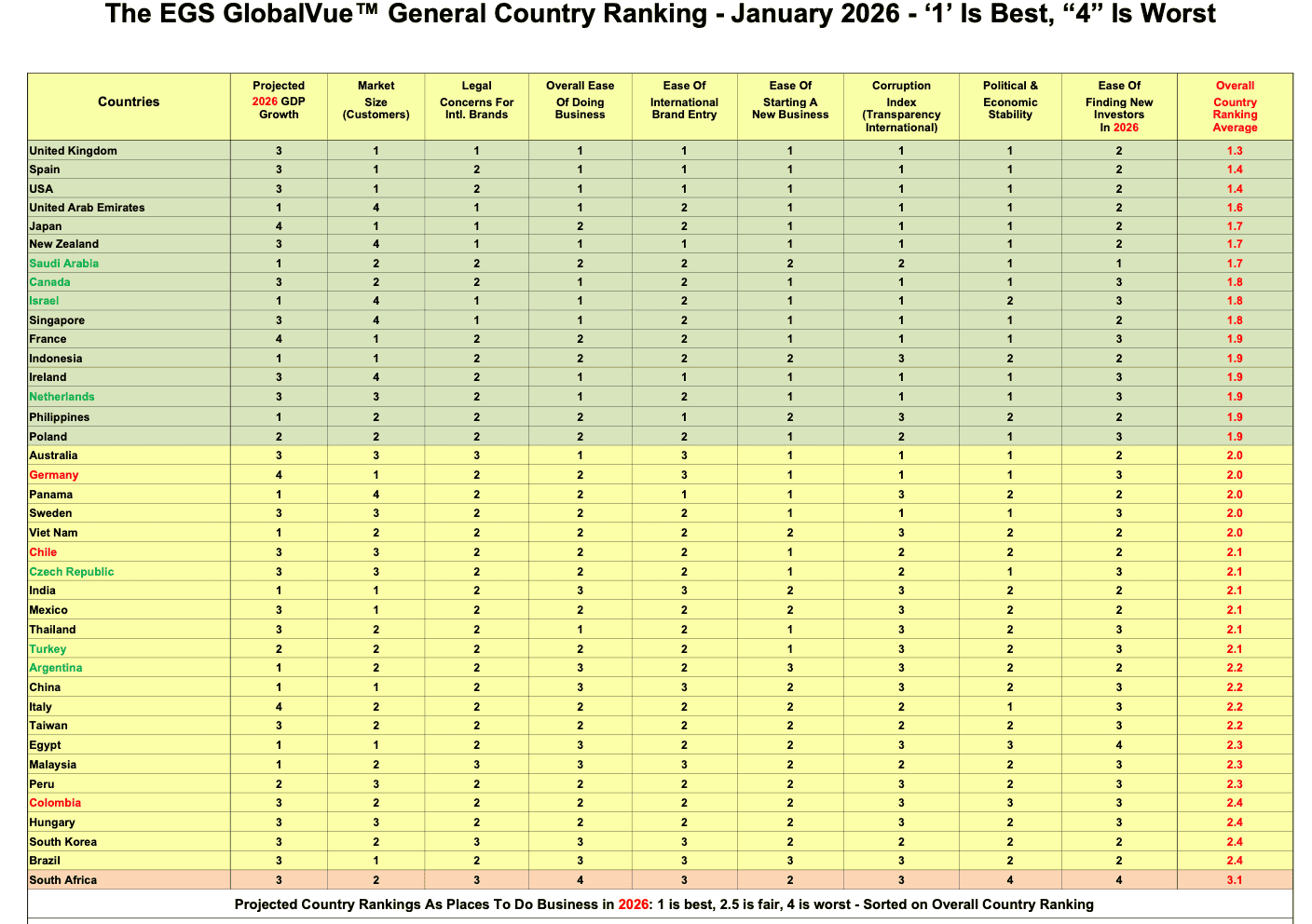
The latest GlobalVue country ranking chart is out. This chart has been published quarterly since 2001 and compares countries as places to do business. A ranking if ‘1’ is best and a ‘4’ is worst. Information to crate and update this chart is from ~40 global business sources which are monitored almost daily. This version of the GlobalVue country ranking is sorted on the overall average of the 9 country ranking parameters as of January 2026.
===============================================================================================
“3 Mistakes Companies Make When Expanding Internationally – Growth blockers can erode the benefits of globalization. Many companies have fallen into the quicksand of jumping into globalization without conducting enough due diligence. An example of a global expansion that went sideways is Home Depot’s failed attempt to gain inroads in China. What went wrong? Consumers in China weren’t motivated to make purchases. Another growth blocker that often surprises businesses is the difference in hiring practices, legal issues, and related expectations around the world. Globalization is worth the effort, but only if you’re dedicated to being pragmatic. Taking a thoughtful and studied upfront approach may delay your break into international markets. Nevertheless, it will prepare you to make your expansion plans work.”, INC. magazine, December 30, 2025
============================================================================================
“These Economists Nailed Their 2025 Forecast: Here’s What They Say About 2026 – Investopedia asked economists at Vanguard to share their predictions for 2026, as their 2025 forecasts are on track to be among the most accurate on Wall Street. The U.S. economy will have solid economic growth, lower unemployment, and slightly lower inflation than in 2026, according to their forecast. Tariffs will continue to push up inflation in 2026, but the economy will likely get a boost from tax cuts, economists said. The year ahead will feature stubborn inflation, an improving job market, and solid economic growth, according to a group of forecasters who nailed their outlook for 2025.”, Investopedia, January 2, 2026
=============================================================================================
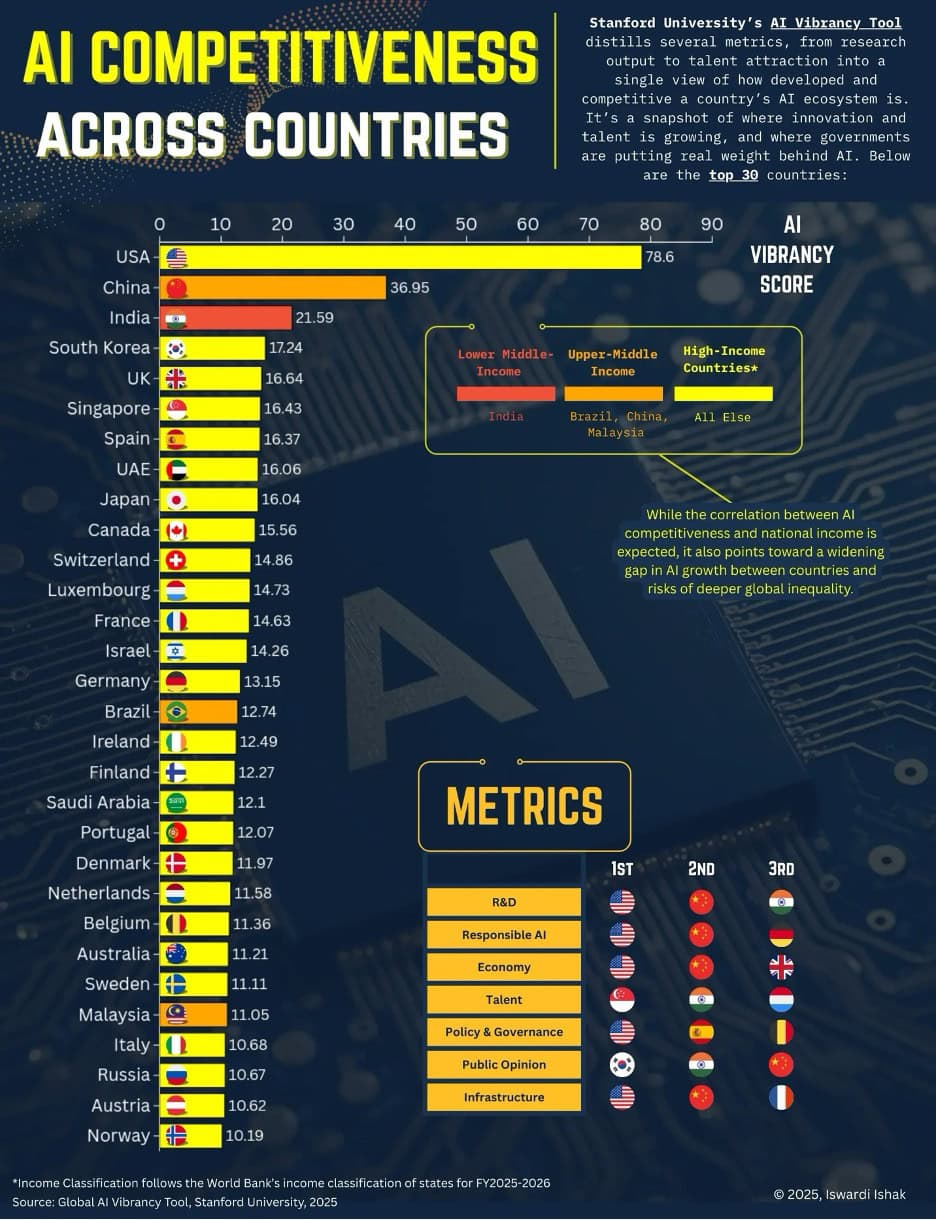
“Visualising AI Competitiveness Across Countries – Artificial intelligence is fast becoming a barometer of national technological ambition. Stanford University’s AI Vibrancy Tool, which blends metrics from research and talent to governance and infrastructure, shows a clear hierarchy in global AI competitiveness. The United States retains a commanding lead followed by China and then India. High-income countries dominate the top ranks, reflecting deep investments in R&D, robust university systems and mature digital infrastructure. India is the only lower-middle-income country to break into the top 30, a sign of its expanding research base and large technical workforce. Brazil, China and Malaysia represent the upper-middle tier, each building out their AI capabilities with state-backed initiatives and growing private-sector activity.”, Visual Capitalist, December 12, 2025
==============================================================================================
“Global employment trends and what’s ahead: 2025 in review and 2026 preview – Global employers are preparing for a new era of workforce planning, compliance, and innovation. Economic and geopolitical uncertainty, rapid technological disruption, and fragmented regulation are rewriting the rules of employment worldwide. Geopolitical and economic uncertainty, as well as technological disruption, are impacting workforce strategies and risks. As AI becomes more embedded in the workplace, jurisdictions around the world are enacting laws to regulate its use – particularly in recruitment, performance management, and employee monitoring.”, Lexology, December 15, 2025
++++++++++++++++++++++++++++++++++++++++++++++++++++++++++++++++++++++++++++++++++++++++++++
Global Supply Chain, Energy, Commodities, Inflation, Taxes, Tariffs & Trade Issues
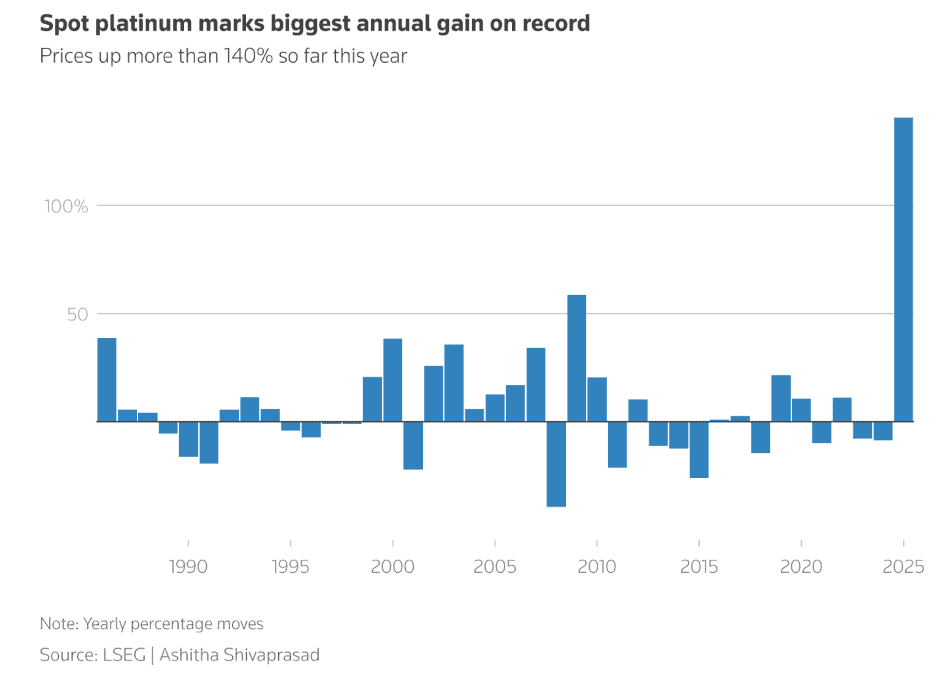
“Platinum set for biggest monthly gain in 39 years on EU auto policy boost – Platinum prices are on track for their strongest monthly rally in nearly four decades in December, fuelled by the EU’s U-turn on its 2035 combustion-engine ban, a tight supply backdrop and rising investment demand for precious metals. Platinum and palladium, both used in autocatalysts that reduce car exhaust emissions, have surged this year as U.S. tariff uncertainty and a rally in gold and silver helped offset long-term headwinds from the rise of electric vehicles. Platinum , also used in other industries such as jewellery, is up 33% so far in December, its biggest jump since 1986, according to LSEG data. After hitting a record high of $2,478.50 per ounce on Monday, the metal is heading for its biggest yearly growth on record of 146%. Its sister metals, palladium and rhodium, are up 80% and 95% respectively so far in 2025.”, Reuters, December 30, 2025
============================================================================================
“U.S. automakers urge Washington to uphold USMCA – The six-year review of the United States-Mexico-Canada Agreement is not scheduled to take place until July, but automakers in the United States are already voicing their support for the continental free trade pact – and calling for the elimination of the Trump tariffs. The agreement, based on the North American Free Trade Agreement that preceded it, has allowed makers of cars and auto parts to boost efficiency and reduce costs by moving production back and forth across borders. The review is happening against a backdrop of trade uncertainty brought about by Mr. Trump, who has imposed tariffs on goods from trading partners – including Canada.”, The Global and Mail, December 26, 2025
===============================================================================================
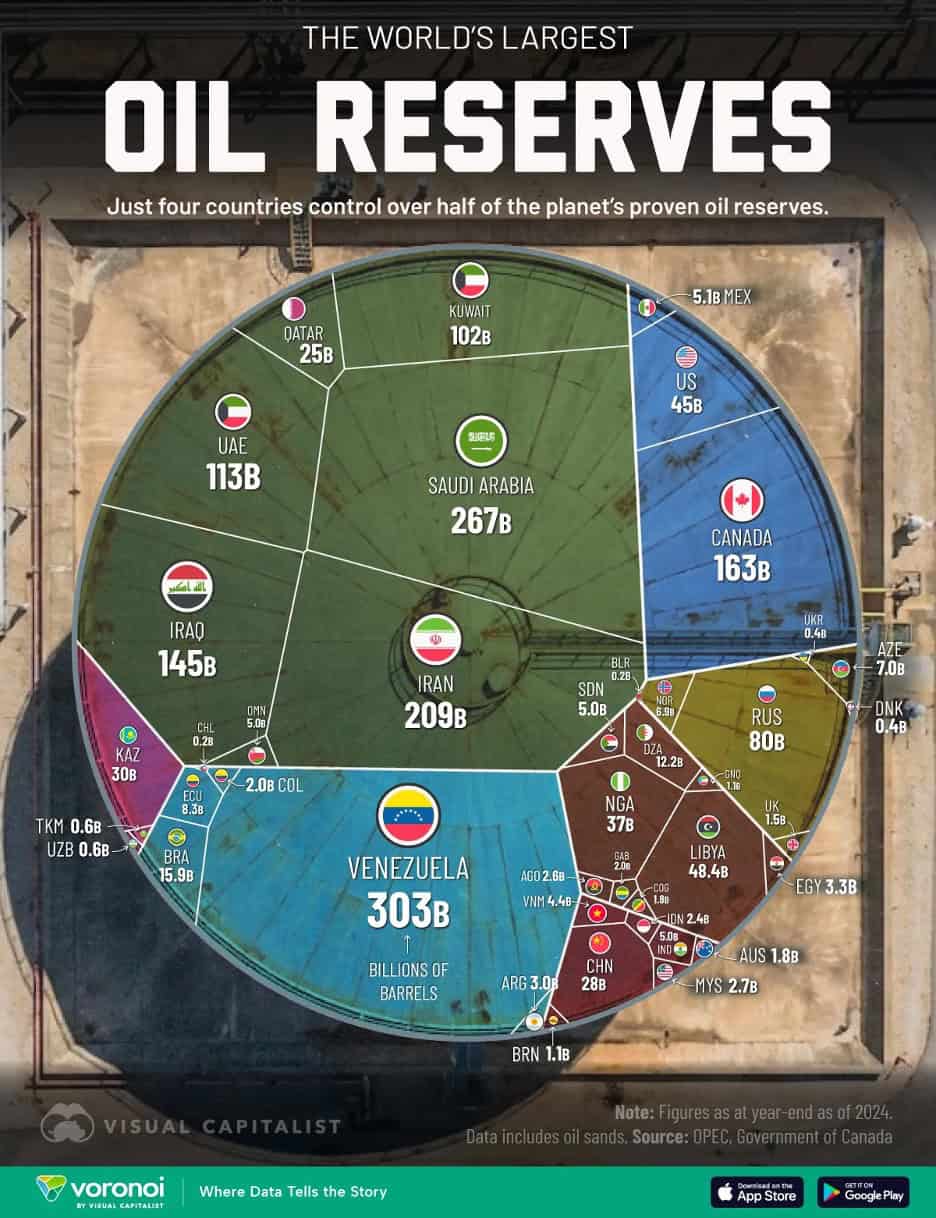
“All of the World’s Oil Reserves by Country, in One Visualization – Just four countries control more than half of the world’s proven oil reserves. Despite the energy transition, fossil fuels still account for nearly 70% of global energy demand. This visualization ranks countries by the size of their proven oil reserves at the end of 2024. The data for this graphic comes from OPEC’s Annual Statistical Bulletin 2025. Figures represent proven oil reserves as of year-end 2024 and are measured in billions of barrels. The data includes conventional crude oil as well as oil sands.”, Visual Capitalist, December 30, 2025
=============================================================================================
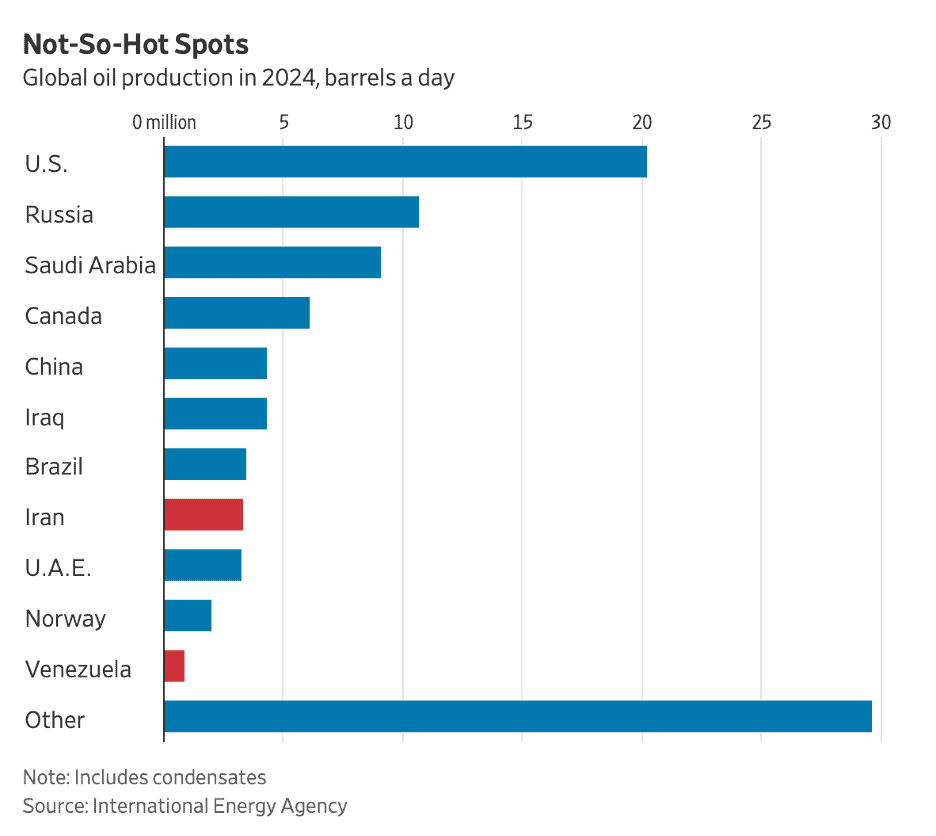
“Not Your Father’s Oil Market: Geopolitical Shocks Lack Impact – Sanctions and fracking have changed the market. The headlines from Venezuela and Iran alone, much less combined, used to be the sort of thing that sent crude prices skyrocketing. Today’s market is different, and that could make a miserable stretch for energy investors even worse. Crude prices have just fallen for an unprecedented third year in a row, and the market remains seriously oversupplied as OPEC unwinds voluntary supply cuts. What is more, there are really two oil markets—the transparent one and the “don’t ask, don’t tell” barrels sold by countries like Russia, Iran and Venezuela operating under sanctions. Many follow convoluted routes via shadow tankers and are snapped up by countries like Turkey, India and China at bargain prices.”, The Wall Street Journal, January 5, 2026
+++++++++++++++++++++++++++++++++++++++++++++++++++++++++++++++++++++++++++++++++++++++++++++
Global & Regional Travel News
Global & Regional Travel News
“2026 travel predictions: The unexpected cities about to take off – Unexpected cities set to steal the spotlight in 2026 travel. Global travel search engine, KAYAK, just released its 2026 Travel Trends forecast, analyzing millions of flight searches to uncover the biggest trends shaping travel in 2026. The data is showing that travelers are ready to make 2026 count — uncovering that travel to Eastern Europe is having a “major moment” and that large-scale pop culture, sports and global events are driving interest in unlikely cities.”, The Manual, December 29, 2025
=============================================================================================
“The Future of Travel – A view from the industry – Travelers are showing changes in behavior as we head toward 2026. While they may increasingly be looking to travel abroad, they’re stretching their budgets to make room for richer, more rewarding experiences. ‘What’s exciting about next year is that our data signals traveler demand and spend is set to increase. 84% of the 22,000 people we surveyed globally said they’d travel more in 2026.’ 84% say they’ll go abroad as much – or more – in 2026 vs 2025.”, Skyscanner, December 2025
++++++++++++++++++++++++++++++++++++++++++++++++++++++++++++++++++++++++++++++++++++++++++++++
Book Review
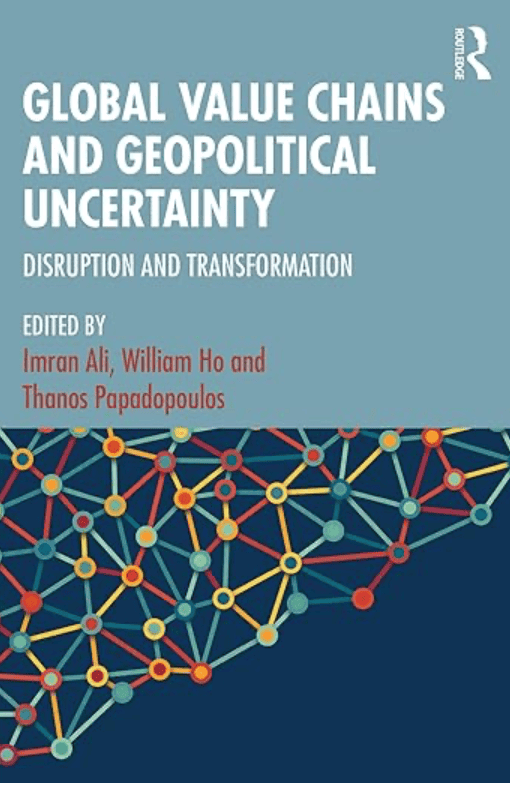
Global Value Chains and Geopolitical Uncertainty: Disruption and Transformation edited by Imran Ali, William Ho, and Thanos Papadopoulos, is a timely guide to how global trade and cross-border operations are being reshaped by a new and lasting reality: geopolitical uncertainty has become a permanent operating condition rather than an occasional disruption. The book examines how political tensions, supply shocks, industrial policy, and fast-moving technologies are changing how goods and services move across borders—and what businesses and governments can do to adapt.
Rather than arguing that globalization is ending, the volume suggests it is evolving into a more complex form, where resilience depends on diversification, visibility, and flexibility across suppliers, routes, and partners. The authors highlight that decisions once driven mainly by cost and efficiency must now incorporate risk, compliance, geopolitics, and strategic autonomy.
A key strength is its use of recent case-based analysis—showing how firms innovate, adapt, and redesign value chains in response to shifting policies, trade barriers, and technology adoption. The book also explores how digital tools—including automation and AI—are both enabling adaptation and creating new vulnerabilities. Ultimately, the editors frame the future of global value chains as a dynamic balancing act: maintaining competitiveness while navigating an environment where policy, security, and economic objectives increasingly collide.
Five Takeaways for Global Businesspeople
Geopolitical risk is now operational risk—build it into sourcing, pricing, and market-entry decisions.
Diversification beats reshoring as a resilience strategy—multiple regions, suppliers, and logistics options matter.
Expect more government involvement (industrial policy, security-driven regulation, subsidies)—and plan accordingly.
Digital tools (AI/automation) are competitive necessities, but they also introduce new dependencies (chips, energy, talent, governance).
Treat your value chain as a portfolio—measure and actively manage trade-offs between cost, resilience, speed, and compliance.
+++++++++++++++++++++++++++++++++++++++++++++++++++++++++++++++++++++++++++++++++++++++++++

+++++++++++++++++++++++++++++++++++++++++++++++++++++++++++++++++++++++++++++++++++++++++++++
Country & Regional Updates
Australia
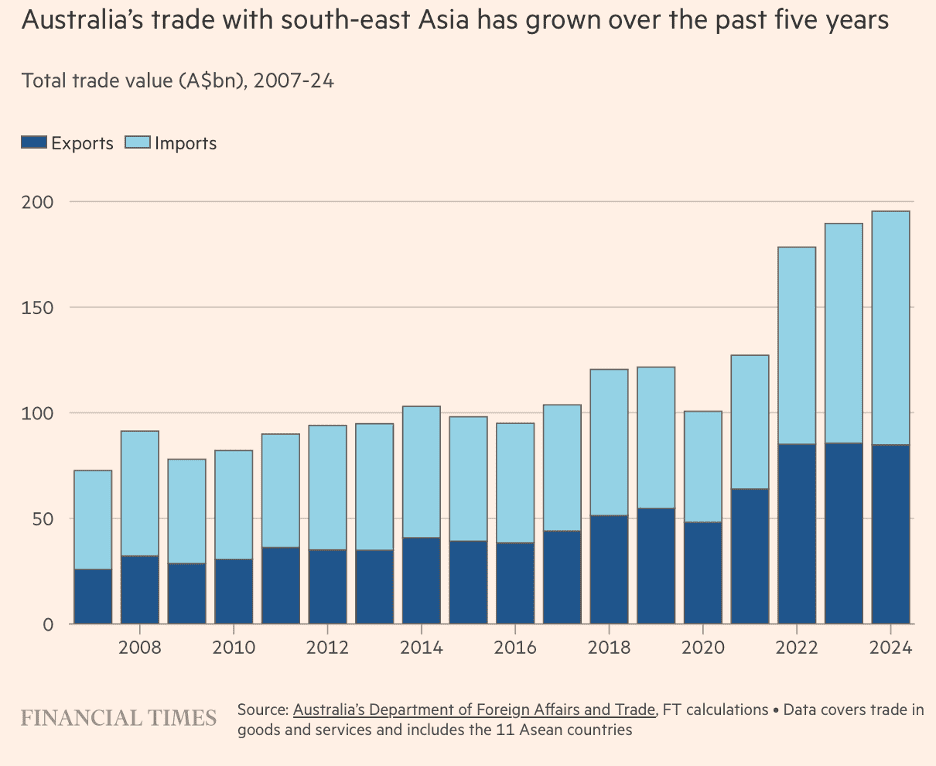
“Australia opens trade frontier on its doorstep as counterweight to China – Canberra pushes to increase business with south-east Asia at a time of heightened trade tensions. South-east Asia was “the fastest growing region in the world”, said Nicholas Moore, the former Macquarie chief executive and Australia’s special envoy to the region. Australian companies and investors who focused on China, the US and Europe risked missing out on the opportunity presented by south-east Asia’s booming middle class and projected GDP growth of between 5 and 6 per cent. ‘There’s a much bigger opportunity to embrace in the region,’ he said, forecasting trade to double over the next 10 years.”, The Financial Times, December 30, 2025
===============================================================================================
China
“Sam’s Club Is Beating Costco at Its Own Game in China – Walmart’s warehouse-club division finds rare success by targeting premium market. Sam’s Club in China has expanded to about 60 stores from 39 three years ago, with some generating over $500 million in annual sales. Walmart’s overall sales in China increased nearly 22% to $6.1 billion in the August-October quarter, making it the company’s fastest-growing international market. Approximately half of Sam’s Club China’s revenue now comes from online shopping, a significant rise from about 4% seven years ago. By contrast, Costco opened its first store in China in 2019 and now has seven locations. The biggest stores each generate more than $500 million in sales annually, according to Walmart.”, The Wall Street Journal, December 28, 2025. Compliments of Paul Jones, Jones & Co., Toronto
=============================================================================================
Canada
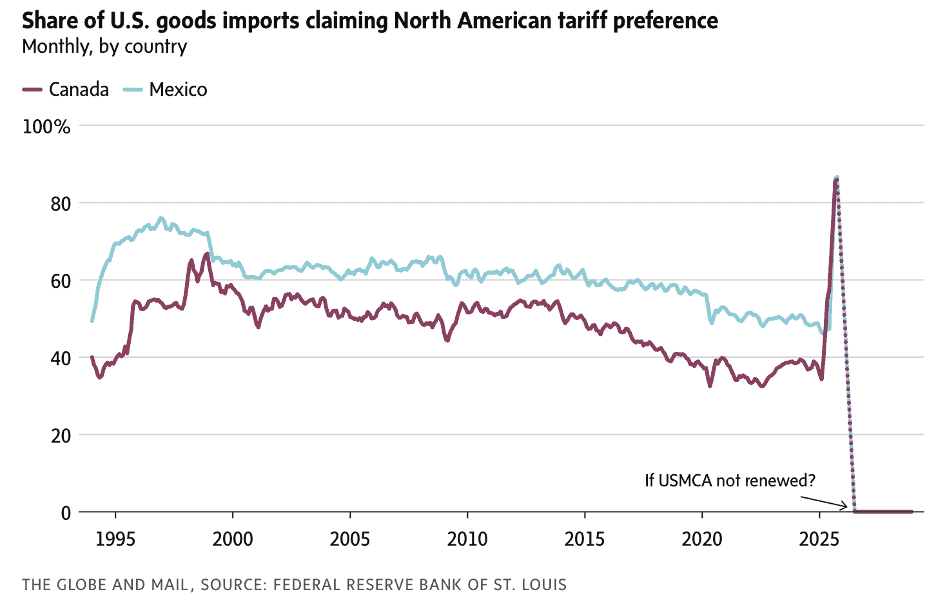
“A tariff road map – The Canada-U.S. trade war is almost a year old – Canada survived Year 1 of the second Trump presidency mostly intact economically, and fully intact sovereignly. What about Year 2? For this series, The Globe asked dozens of economists, analysts and investors to pick a chart they think will be important in 2026. Canadian businesses are also succeeding in rotating their export markets faster than many analysts expected. Tapping into 27 trading partners, Canadian firms have recovered nearly $11-billion of the $18.5-billion loss to the United States. Looking ahead to the (USMCA trade agreement) 2026 renewal, if the U.S. threatens to withdraw – or actually walks away – Canada and Mexico would face another major trade shock, causing more disruption across the North American economy.”, The Global and Mail, January 1, 2026
=============================================================================================
Europe
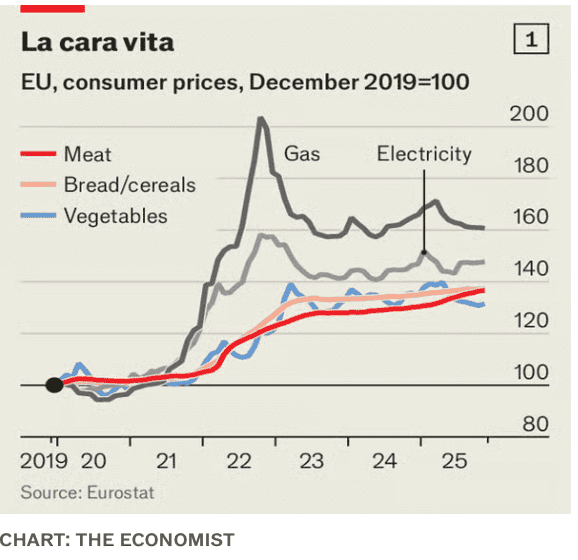
“Forget affordability. Europe has an availability crisis – Tight regulation is largely to blame. At first glance, Europeans have reason to be concerned about affordability. In fact, the continent’s problem increasingly seems to be not affordability but availability. In its highly regulated markets, prices cannot adjust to balance demand and supply. Rationing is doing the job instead. The share of households paying more than 40% of disposable income on accommodation has, if anything, fallen since 2021. The true difficulty is finding a place at all. When a flat does become available, it can attract hundreds of applications. In health care, another regulated market, a doctor’s appointment can be hard to obtain.”, The Economist, December 30, 2025
============================================================================================
India
“India ‘spreads its bets’ to beat Trump’s 50% tariff as exports rise – With exports hitting a record US$825 billion and a spate of new trade pacts, India is finding success diversifying away from the US. Ever since US President Donald Trump imposed import tariffs of 50 per cent on India last year, among the highest levied by Washington, the South Asian nation has maintained a resolute approach to the punitive levies, even as it has kept the door open to negotiations. After concluding the trade deal with New Zealand last month, Indian Commerce Secretary Rajesh Agrawal said in a social media post that it was the third such arrangement signed last year, following earlier pacts with the United Kingdom and Oman. Analysts predict that an interim trade deal between the US and India is still likely to materialise in the coming months, rather than a full-blown free-trade agreement.”, The South China Morning Post, January 4, 2026
============================================================================================
Indonesia
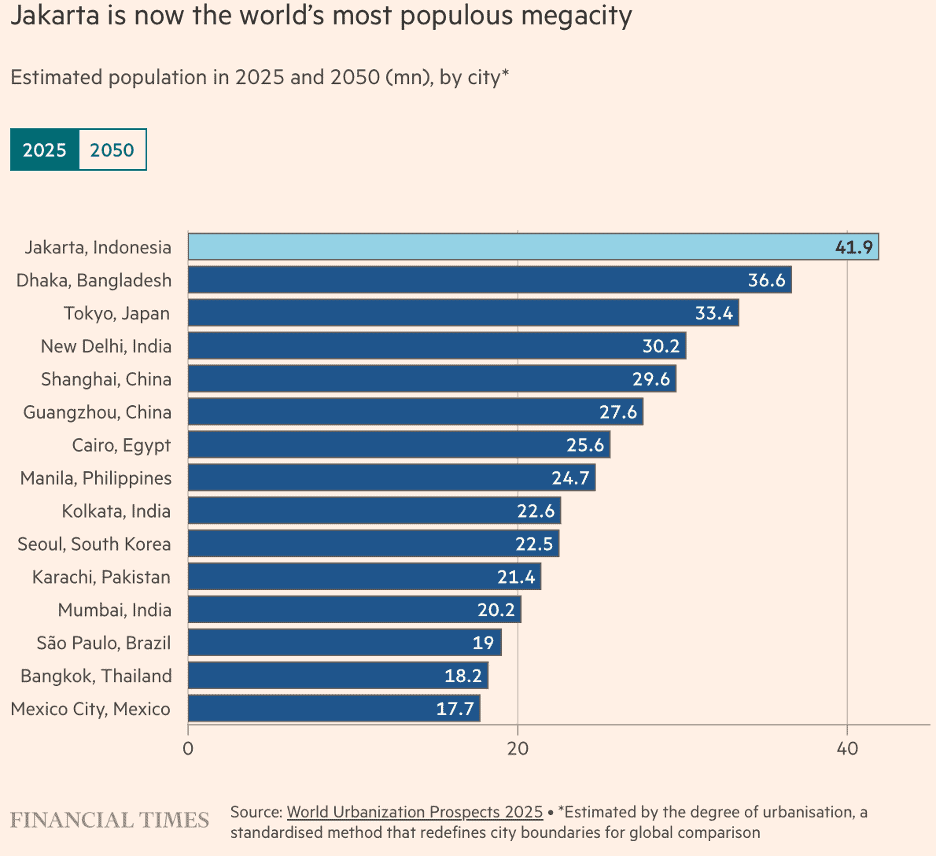
“Move over, Tokyo — the world has a new biggest city – Jakarta and its sprawling environs’ 42mn inhabitants are now the most populous conurbation, according to the UN. Last month, the UN updated its list of the world’s biggest cities after changing its methodology for assessing huge conurbations. It looked beyond Indonesia’s own 11mn reckoning of Jakarta’s population, sweeping into its calculations a much bigger urban area covering sprawling satellite towns such as Bogor…… Jakarta’s problems are reflective of other rapidly growing cities in Asia, which the UN says is now home to about half of the world’s 33 megacities — defined as urban areas with at least 10mn people.”, The Financial Times, December 27, 2025
Editor’s Note: Bill Edwards lived in Jakarta in 1975 and 1976 when the core population was estimated to be 5 million people versus 11 million today. Traffic was bad even then!
===========================================================================================
South-East Asia
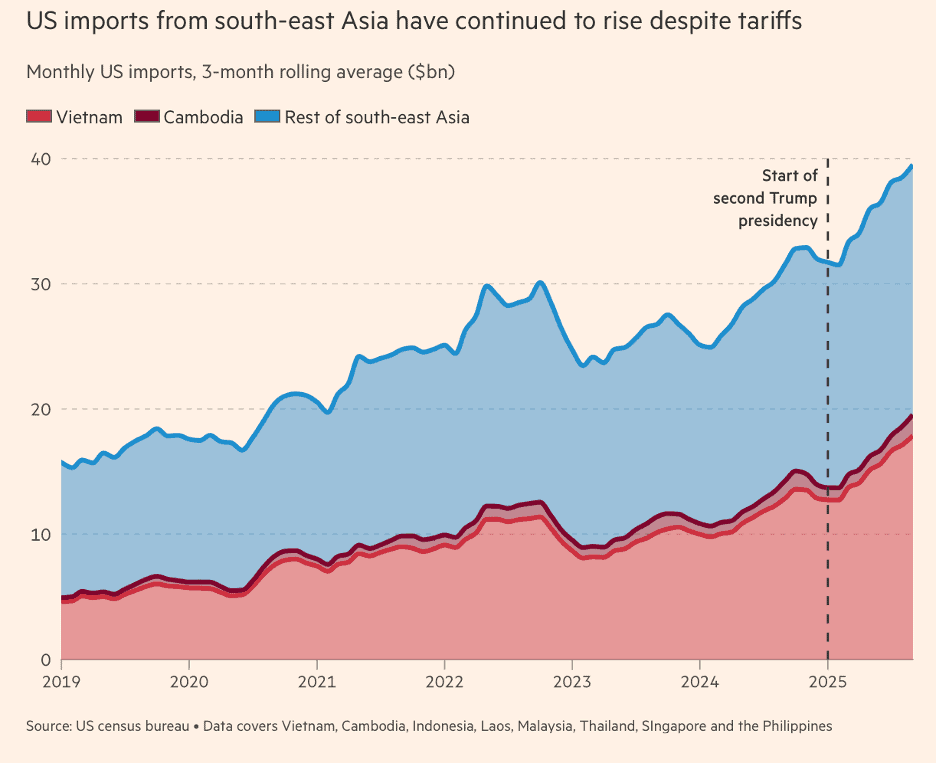
“How south-east Asia is riding out Trump’s tariff storm – Rerouting of goods from China plus US demand for tech products is propping up trade in the region. Goods exports from south-east Asia to the US rose 25 per cent between July and September relative to the same period in 2024 despite the US president’s trade war, according to data from the US Census Bureau. Foreign investments into the region’s main manufacturing economies have also increased, driven by global efforts to diversify supply chains. While Chinese exports to the US were down by 40 per cent in the third quarter of 2025 compared with a year earlier, overall Asian exports to the US have held firm, according to US Census Bureau data.” The Financial Times, January 4, 2026
===========================================================================================
United Kingdom
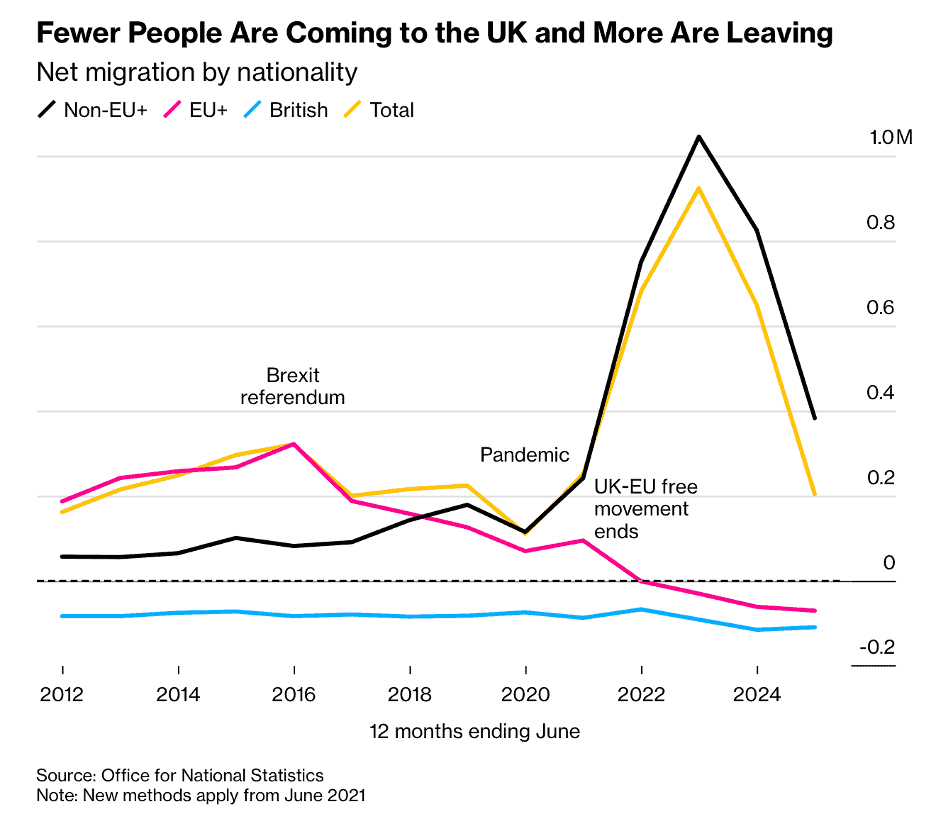
“UK to Pass Population Tipping Point in 2026, Think Tank Says – The number of people who die in Britain this year is set to exceed those born in the country, according to the Resolution Foundation. Britain will see a shortfall in births in 2026, with any population growth from then on set to come from international net migration, the think tank said. The UK’s projected shortfall in births mirrors trends elsewhere in Europe and across the developed world, fueling support for policies to encourage women to have more children. A separate quarterly survey by the British Chambers of Commerce found that confidence has continued to weaken following the November budget to its lowest level in three years, with retail and hospitality the worse affected. The level of tax remains the biggest concern for business, following the £26 billion ($35 billion) payroll levy that came into effect last year and recent increases in business rates.”, Bloomberg, January 4, 2026
============================================================================================
United States
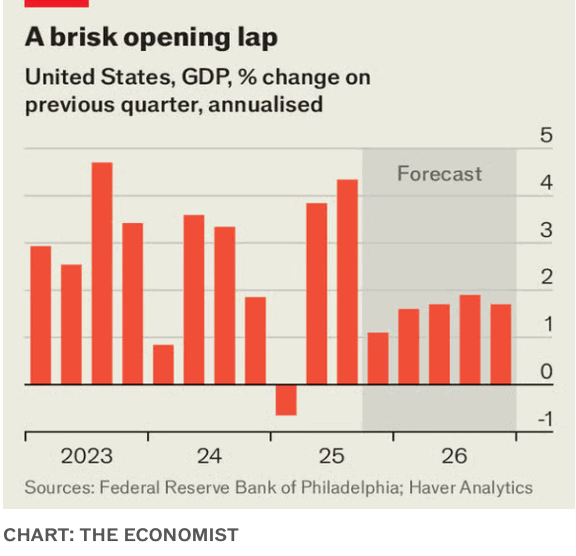
“America’s economy looks set to accelerate – A monetary-fiscal loosening is coming. The effects of the One Big Beautiful Bill Act, a tax-cutting law enacted in July, will soon start to be felt. Americans will receive refunds that reflect retroactive tax cuts on income from 2025. They will also find that levies on monthly earnings have fallen. According to Piper Sandler, an investment bank, these “two years of tax cuts in one” are worth about $191bn. Such tax-cutting should be enough to boost gdp by 0.3%—a reasonable stimulus given the economy probably grew by 1.9% in 2025. For all these reasons a vocal minority of analysts say that 2026 will be a year of strong economic growth. Some expect it to be an international story.”, The Economist, December 30, 2025
============================================================================================
“US economy expected to grow faster in 2026 despite stagnant job market – Goldman Sachs predicts growth acceleration as $100B in tax refunds and reduced tariff drag boost economic momentum. Goldman economists see the U.S. economy growing at a faster rate in 2026 with the firm forecasting 2.6% real GDP growth, above the Bloomberg consensus of 2%. That continues a post-pandemic trend of optimism around the U.S. economy relative to consensus forecasts. The Goldman Sachs economists estimate that consumers will receive an extra $100 billion in tax refunds in the first half of next year, which is equivalent to about 0.4% of annual disposable income. Additionally, they note that OBBBA’s business tax provisions allowing full expensing of plant and equipment spending ‘has already started to boost forward-looking capex indicators.’”, Fox Business, December 29, 2025
++++++++++++++++++++++++++++++++++++++++++++++++++++++++++++++++++++++++++++++++++++++++++

The Accredited Franchise Supplier certification
+++++++++++++++++++++++++++++++++++++++++++++++++++++++++++++++++++++++++++++++++++++++++++++
Global Brand & Franchise Sector News
“2025 was a year of hope for full-service restaurants – FSRs had plenty to celebrate as consumers rekindled their love for sit-down dining. But there were challenges too, including a steady stream of bankruptcies. In a year in which consumers grew increasingly fed up with inflation, full-service restaurant chains broke through with an appealing proposition: A full meal, a drink or two, plus friendly service, for a reasonable price. But 2025 wasn’t without its warts. A steady drumbeat of full-service bankruptcies continued, and a turnaround at Cracker Barrel came to a screeching halt following its logo blowup.”, Restaurant Business, December 18, 2025
==============================================================================================
“KFC, Pizza Hut India Operators to Merge in $933 Million Deal – Two franchise operators of KFC and Pizza Hut restaurants in India, Devyani International Ltd. and Sapphire Foods India Ltd., have agreed to merge in a share-swap deal worth about $933 million. The deal will create economies of scale, reduce overheads, boost operational efficiencies, and enhance bargaining power with suppliers and vendors, according to the two franchisees. The merged unit will focus on accelerating KFC’s expansion, strengthening Pizza Hut for long-term growth, and scaling emerging brands, and is expected to see potential synergy benefits of as much as 2.25 billion rupees annually from the second full-year of the merged operations.”, Bloomberg, January 1, 2026
===============================================================================================
“Here’s What You’ll Find On Popeyes’ Menus Outside Of The US – Popeyes is the place to patronize when you’re pining for poultry — well, chicken to be exact. The chain was founded in 1972 and has found global success over the decades, with thousands of locations in all corners of the world as of 2025. While the bulk of them are in the U.S., it has seen consistent growth in other parts of the globe. It actually opened the first non-U.S. store way back in 1991 in Malaysia, and now it has more than 1,200 international locations in 35 countries. Who doesn’t love loaded fries? Well, if you head to a Popeyes U.K. location, then make sure to order the cheesy loaded fries straight away. Spaghetti isn’t a dish we’d think Popeyes would serve, and yet you can order it if you head over to the Philippines.”, Tasting Table, December 27, 2025
===============================================================================================
“Red Lobster’s 36-year-old CEO led the company after bankruptcy. Now he’s plotting the ‘greatest comeback in the history of the restaurant industry’ – Red Lobster entered bankruptcy in 2024, but quickly clawed its way out in just about three months. The once-struggling 57-year-old seafood chain had endured an $11 million endless-shrimp fiasco among other mistakes made. But under the leadership of Damola Adamolekun, 36, who was previously the CEO of P.F. Chang’s, Red Lobster has officially turned the ship around. As the company continues to recover from bankruptcy, the chain expects positive net income in fiscal 2026, and adjusted EBIDTA is expected to grow 43% from fiscal 2025 to 2027.”, Fortune, January 2, 2026
==============================================================================================
“McSpaghetti to McAloo Tikki: Inside the world’s local McDonald’s – From paneer wraps in India to ski-through burgers in Sweden, photojournalist Gary He’s new book McAtlas shows that the world’s most global chain is also one of the most local. “McDonald’s has a reputation for cultural imperialism, but that’s not 100% true,” declares photojournalist Gary He. In his new book McAtlas, He challenges assumptions about the global fast-food giant, which operates 42,000 stores in more than 100 countries and serves 65 million people a day. While many believe McDonald’s has homogenised food culture worldwide, He argues the opposite: that the company has thrived by adapting its menu, architecture and brand to local palates and traditions. ‘McDonald’s has succeeded because they have brilliantly incorporated local flavours and ingredients – from the McRaclette in Switzerland to egg bulgogi burgers in South Korea and the Halloumi McMuffin in Jordan,’”, BBC, September 5, 2025
=============================================================================================
“Burger King to open 30 new UK restaurants in 2026 – This will bring the number of Burger King restaurants in the UK to more than 600. Burger King UK has announced ambitious plans to launch 30 new restaurants in 2026 despite facing “softer” consumer confidence and mounting pressure from increased labour costs. The revelation comes as the fast-food giant disclosed stronger revenues amid a ‘challenging’ economic climate. Plans have been unveiled to open approximately 30 restaurants each year from 2026 onwards, with particular emphasis on new company-owned locations.”, Express UK, December 30, 2025
++++++++++++++++++++++++++++++++++++++++++++++++++++++++++++++++++++++++++++++++++++++++++++++
To receive our biweekly newsletter in your email every other Tuesday, click here – https://insider.edwardsglobal.com
+++++++++++++++++++++++++++++++++++++++++++++++++++++++++++++++++++++++++++++++++++++++++++++++
Our Mission, Information Sources & Who We Are
Our biweekly global business update newsletter focuses on what is happening around the worldthat impacts new trends, health, consumer spending, business investment, the franchise sector, economic development, and travel. We daily monitor 30+ countries, 40+ international information sources and six business sectors to keep up with what is going on in this ever-changing business environment. And our GlobalTeam on the ground covering 25+ countries provide us with updates about what is actually happening in their specific countries. We do not get involved in or report on politics!
+++++++++++++++++++++++++++++++++++++++++++++++++++++++++++++++++++++++++++++++++++++++++++
William “Bill” Edwards: CEO & Global Trade Advisor “Is Uniquely Qualified to Steer Sr. Executives Successfully Through the Complex Waters of Going Global”. With five decades of successful international business experience spanning virtually every corner of the world and many business sectors, Bill Edwards understands the global business landscape like no other. He has been a County Master Franchisee in five countries in Asia, Europe, and the Middle East; the Senior VP for a franchisor operating in 15 countries and a full-service global management consultant since 2001 helping 40+ franchisors expand into new countries. Bill knows how to turn the challenges in taking a brand global into opportunities.

For a complimentary 30-minute consultation on how to take your business into new countries successfully. For a complimentary call with Bill Edwards click on the QR code or contact Bill at bedwards@edwardsglobal.com and +1 949 375 1896
And download our latest chart ranking 40+ countries as places to do business, used by many companies for strategic planning, at this link: